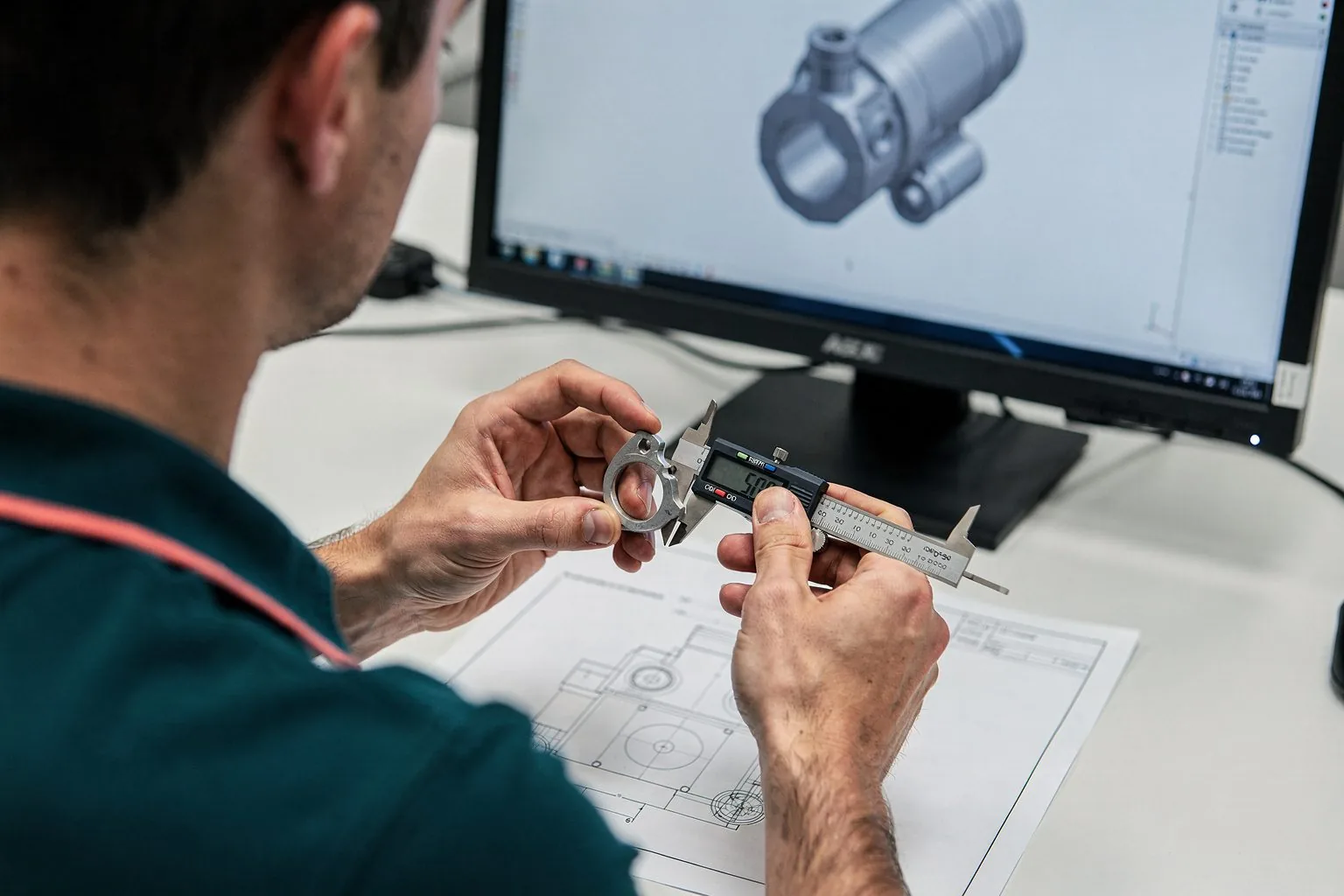
Engineering — in-house, before any partner shop touches your file.
DFM review, tolerance analysis, material selection, process recommendation, value engineering, and reverse engineering — performed by the GPW engineering team in Monterrey. This is the one Contract Manufacturing service we do not subcontract — the partner network builds your part, but the engineering work stays with us. Free on every RFQ. 48–72-hour turnaround.
The engineering happens before the part goes to a partner shop.
The other five Contract Manufacturing services (milling, turning, EDM, sheet metal, finishing) all follow the same pattern: GPW coordinates a network of qualified Mexican shops. Engineering Support is the exception. The DFM review, tolerance analysis, material recommendation, process selection, and reverse engineering are all done by GPW engineers, in-house, in Monterrey — before any partner shop ever opens your file. That matters because it means your design feedback comes from people who see what every partner in our network can and cannot do.
Not a third-party DFM tool. Not the partner shop's quoter. The same team that selects partners and signs off on QC reviews your file first — in person, in CAD.
Knowing which partner can hold ±0.0005" on stainless 316 and which cannot is itself an engineering input. We use that knowledge to flag tolerances that look "standard" on paper but are actually capacity-limited.
Every RFQ gets engineering review — no charge, no obligation, no upsell. We bill the manufactured parts. Engineering is how we make sure the parts are right the first time.
Six engineering services on the same desk.
Every service below is performed by GPW engineers. None is outsourced. All are free for active RFQs and customers; the deeper VA/VE and reverse-engineering work can also be quoted as standalone projects.
Free with every RFQ. Specific, not generic.
Most platforms run automated DFM in the cloud — useful for catching obvious red flags, blind to anything an experienced machinist would actually flag. Our DFM is done by a person, on your file, in 48–72 hours.
The cost of a tolerance is rarely linear.
Most parts inherit tolerances from a template, a previous revision, or "what we always use" — not from a stack-up calculation. Tightening one tolerance from ±0.005" to ±0.001" can quadruple part cost. We do the math.
The right alloy is rarely the most familiar one.
Specifying 7075 because it's "stronger" or 316 because it's "more corrosion-resistant" can double your cost when the application doesn't require it. We weigh strength, environment, machinability, weight, cost, and lead time — with data, not opinions.
Mill, turn, EDM, sheet, or a sequence of all four.
Some parts have one obvious process. Many do not. We evaluate the geometry and tell you which process (or sequence) makes the most sense — including the cases where mill-then-turn-then-EDM-then-finish beats any single-process approach.
For parts already in production with another supplier.
DFM is for new designs. VA/VE is for parts you have been ordering for months or years — where the design is locked, the supplier is comfortable, and nobody has questioned the cost since revision 0.
Tolerance Relaxation
"This Ø is ±0.0005" but it's a clearance bore with 0.010" play. Relaxing to ±0.002" eliminates a grind op — 25% cost out."
Material Substitution
"This bracket is 7075 but carries no structural load. Switching to 6061 cuts material 40% and machines 15% faster."
Part Consolidation
"These 2 parts always bolt together as a pair. Machining as one piece eliminates 4 fasteners, 2 assembly steps, 1 drawing."
Process Change
"This runs on 5-axis because of one 15° face. A 15° fixture lets it run on 3-axis at half the cycle time."
Inspection Reduction
"100% inspection is specified on all 14 dimensions. Only 3 are functional — SPC sampling on the rest cuts QC cost in half."
Finishing Optimization
"Type III hard coat on the entire part. Only the bore wears — selective hard coat or Type II elsewhere cuts finish cost 60%."
Physical part → CAD model + drawing → production.
Lost the original CAD. Inherited a legacy part. Buying from a supplier that just went out of business. Need to replicate a worn-out spare. We measure the part, build the model, deliver the drawing, then quote the manufacturing.
4 steps from upload to engineered quote.
Upload Your Files
CAD (STEP, IGES, native) + drawing (PDF, DXF), or a sketch / photo / physical part. NDA signed before file receipt — your or ours.
Engineering Review
GPW engineers (in-house) review within 48–72 hours: DFM feedback, tolerance comments, material suggestions, process recommendation.
Quote With + Without
You receive the part quote both as drawn AND as recommended — side-by-side cost comparison so you can see what each suggestion saves.
You Decide
Every recommendation is optional. Tight tolerance for a reason? Keep it. Material specified by your customer? Respected. We show options — you call it.
Engineering support across every industry we serve
Engineering Support — answered.
Is the DFM review really free?
Yes — on every RFQ, no exceptions. We do it because it cuts cost and prevents quality issues, which makes the project go smoother for both sides. There is no catch and no obligation to proceed with a quote afterward.
Is the engineering done in-house or outsourced?
In-house. This is the only Contract Manufacturing service GPW does not subcontract — every DFM review, tolerance analysis, material recommendation, and reverse-engineering project is performed by GPW engineers in Monterrey. The partner shop network handles the physical manufacturing; the engineering work stays with us.
What file formats do you accept?
STEP (preferred), Parasolid (.x_t), IGES, DXF, DWG, PDF drawings, and native files from SolidWorks, Fusion 360, Inventor, and CATIA. If you only have a sketch on paper, take a photo and send it — we have worked with less.
What if I do not have a CAD file?
Send a drawing, a sketch with dimensions, or the physical part. Our reverse engineering service measures existing parts (calipers, micrometers, or 3D scanning when called for), creates a fully toleranced CAD model, and produces drawings that can be quoted and manufactured.
Do you sign NDAs?
Yes. We sign your NDA or provide ours before receiving any files. Standard practice on every project — confidentiality is the default, not an add-on.
How detailed is the DFM feedback?
Specific and actionable, not generic. Not "this wall is thin" — instead: "This 0.8 mm wall in 7075 aluminum will deflect during machining and require custom fixturing. Increasing to 1.5 mm eliminates the fixture and reduces scrap risk. Estimated cost impact: −15% per part."
Can you help with parts already in production?
Yes — that is Value Engineering (VA/VE). Send us your current drawing and a production part. We analyze the design and process to identify cost reduction opportunities — tolerance relaxation, material substitution, part consolidation, or process change — then quote both the current part and the optimized alternative.
What language is the engineering review delivered in?
English by default, Spanish on request. The GPW engineering team is bilingual and delivers DFM reports, drawings, and CAD comments in either language.
Send us your design — free DFM review in 48–72 hours.
CAD file, drawing, or even a sketch. Our engineering team responds within 48–72 hours with specific recommendations to improve manufacturability and reduce cost. No charge. No obligation. No sales pitch.
In-house GPW engineers · NDA signed first · sales@gpw-solutions.com