Energy Equipment Assembly — Engineered for Reliability, Built for Decades of Service
Global Precision Works (GPW) assembles power distribution cabinets, control systems, and energy infrastructure equipment for U.S. OEMs — with the build quality, environmental ratings, and documentation rigor that field-deployed energy hardware demands.
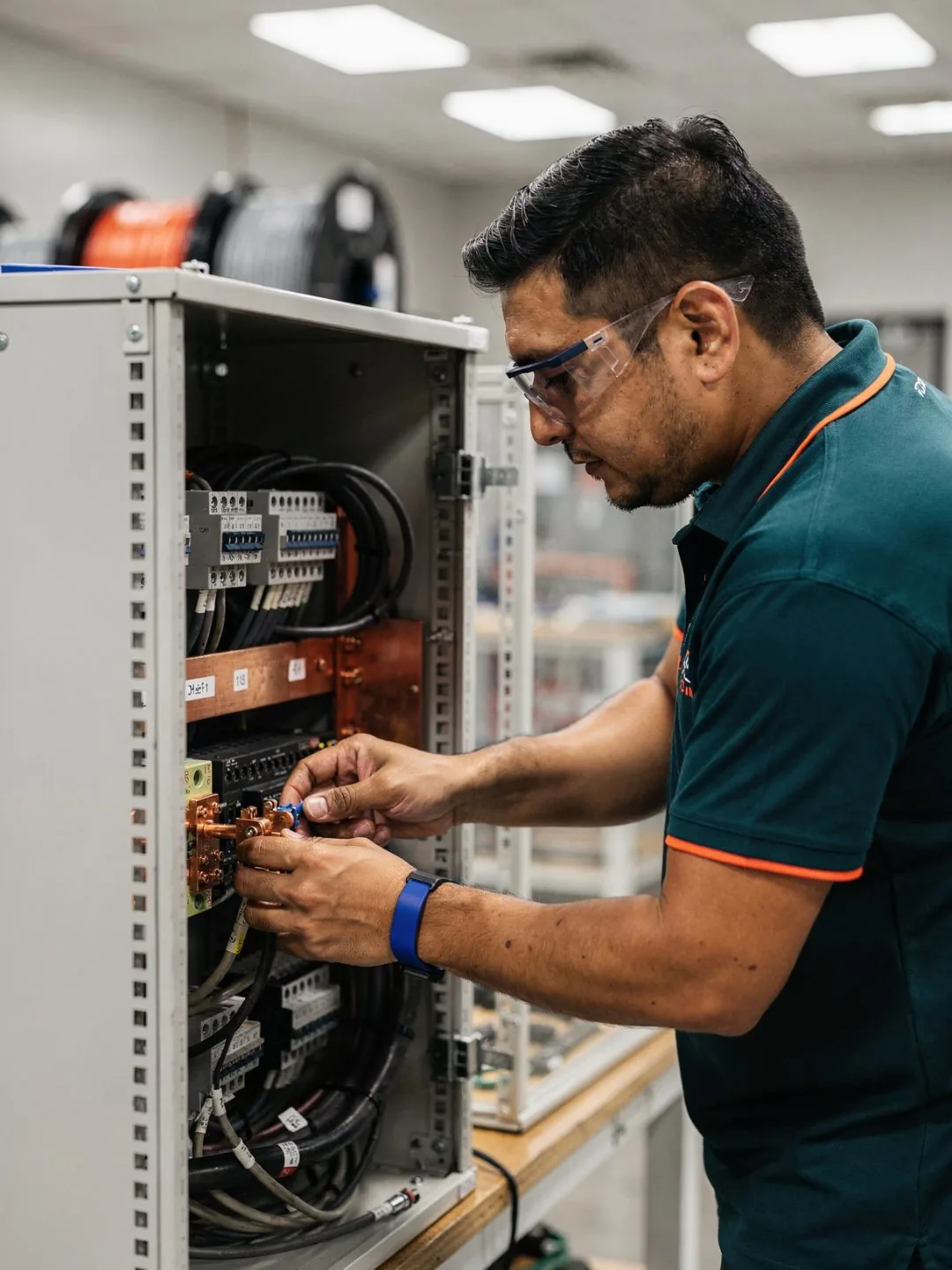
Energy equipment operates in environments where failure is not an option. Power distribution cabinets at substations, control systems at generation facilities, and equipment enclosures at renewable energy sites run continuously in conditions that test every assembly decision — extreme temperatures, humidity, vibration, and electrical stress. The hardware must perform reliably for 15-25 years with minimal maintenance access.
GPW assembles that hardware. Our Monterrey facility builds energy sector equipment across a range of product types: power distribution cabinets, motor control centers, switchgear sub-assemblies, renewable energy inverter enclosures, and system-level integration builds. Every program follows documented procedures, every unit passes through defined test protocols, and every assembly is traceable from incoming components through final shipment.
This is assembly built for energy infrastructure. GPW understands that a loose termination inside a power cabinet creates an arc flash risk, that an improperly rated enclosure seal fails in the first season of outdoor deployment, and that energy equipment ships on project timelines tied to construction schedules and regulatory deadlines. Your hardware is built to last, tested to verify, and delivered on schedule.
What Is Energy Equipment Assembly?
Energy equipment assembly is the process of integrating electrical, electromechanical, and mechanical components into finished power distribution, control, and infrastructure equipment — cabinets, switchgear sub-assemblies, motor control centers, inverter enclosures, battery management systems, and system-level builds for generation, transmission, distribution, and renewable energy applications. It takes individual components — bus bars, circuit breakers, contactors, relays, transformers, wiring, enclosures, and structural hardware — and builds them into a tested, documented unit rated for field deployment in energy infrastructure. For OEMs that design energy equipment, contract assembly transfers the build process to a specialized partner so the OEM can focus on product engineering and project delivery.
Energy Infrastructure Is Expanding — Assembly Capacity Needs to Scale with It
The energy sector is in the middle of a generational build cycle. Grid modernization programs, renewable energy deployment at scale, battery energy storage systems, EV charging infrastructure, and aging grid replacement are driving demand for physical hardware at volumes that strain existing manufacturing capacity. The U.S. Department of Energy estimates that transmission and distribution infrastructure investment will exceed $100 billion over the coming decade — and every dollar of that investment translates into physical equipment that must be assembled, tested, and deployed.
At the same time, the equipment itself is growing more complex. Modern power distribution cabinets integrate digital monitoring, communications modules, and smart grid interfaces alongside traditional bus bar and circuit breaker assemblies. Renewable energy equipment — inverter enclosures, battery management cabinets, solar combiner boxes — combines power electronics with environmental protection and thermal management in configurations that did not exist a decade ago.
Continue reading Show less
For U.S. energy equipment OEMs, this creates a familiar challenge. Domestic assembly capacity is constrained and expensive. Skilled labor for cabinet wiring and electrical integration is difficult to recruit and retain. Offshore assembly introduces lead times that conflict with construction-driven project schedules — a power cabinet that arrives 2 weeks late can delay the energization of an entire substation.
The result is growing demand for nearshore partners who can deliver energy-grade build quality at competitive cost, with the proximity and responsiveness that project-driven delivery schedules require. Energy OEMs need a partner who understands that a torque specification on a bus bar connection is not a suggestion — it is a safety requirement that determines whether the equipment operates safely for the next 20 years.
GPW is built for this work. Process-controlled, documentation-rigorous, and focused on building energy equipment that performs as reliably as the infrastructure it serves.
What GPW Builds — Cabinets, Control Systems, and Power Infrastructure Equipment
GPW assembles energy sector equipment across a range of product types and voltage classes. Every program operates under documented procedures with defined quality gates, torque verification, and full component traceability.
Power Distribution Cabinet Assembly
Power distribution cabinets form the backbone of electrical infrastructure — in substations, generation facilities, commercial buildings, and industrial plants. GPW assembles these cabinets: bus bar fabrication and installation with torque-controlled connections, circuit breaker mounting, contactor and relay installation, power wiring, control wiring, grounding bus assembly, and labeling per the OEM’s specification.
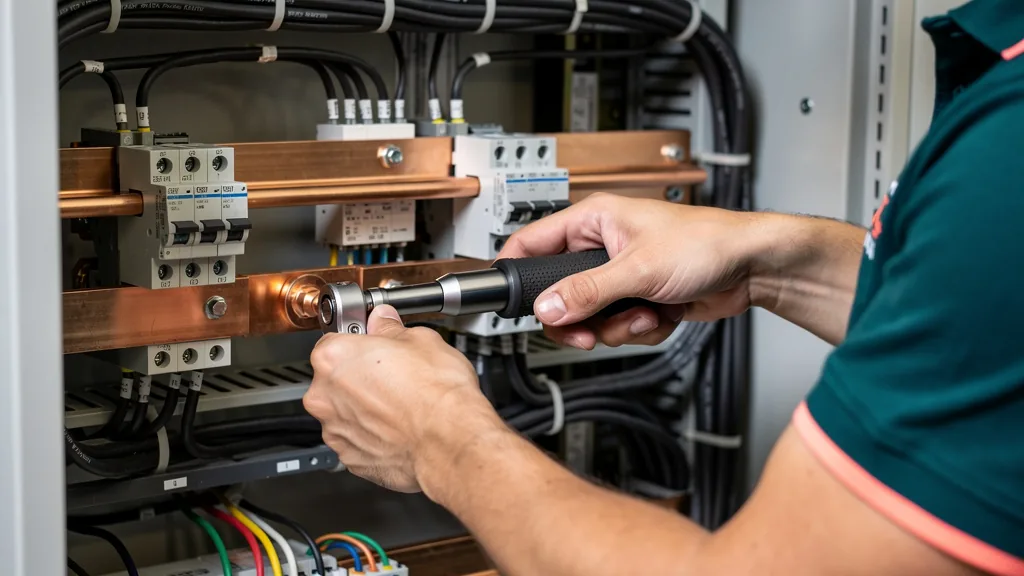
GPW’s cabinet assembly process addresses the specific safety requirements of power distribution equipment. Bus bar connections are torqued to manufacturer specifications and verified with calibrated tools. Wire routing maintains clearance and creepage distances required by the equipment’s voltage rating. Every connection point is documented in the assembly record.
For OEMs producing multiple cabinet configurations, GPW manages variant control across the product family — ensuring the correct bus bar rating, breaker configuration, and wiring schematic are applied to each unit without ambiguity.
Motor Control Center and Switchgear Sub-Assembly
Motor control centers (MCCs) and switchgear assemblies integrate multiple functional units — motor starters, variable frequency drives, soft starters, and protection devices — into a common enclosure structure. GPW assembles individual MCC units and switchgear compartments: component mounting, power bus connections, control wiring, unit-level testing, and documentation that supports the OEM’s final system integration.
Renewable Energy Equipment Assembly
The renewable energy sector generates demand for specialized equipment assemblies — solar inverter enclosures, battery energy storage system (BESS) cabinets, solar combiner boxes, and EV charging equipment housings. GPW assembles this equipment with attention to the thermal management, environmental sealing, and power electronics integration that renewable applications require.
Inverter enclosures integrate power electronics modules, cooling systems, AC/DC bus connections, and monitoring interfaces. BESS cabinets combine battery module mounting, battery management system wiring, thermal management, and safety interlock systems. GPW builds these assemblies following the OEM’s environmental rating specification — NEMA 3R, NEMA 4, or IP-rated — with sealing verification as a documented quality gate.
Control System and Instrumentation Cabinet Assembly
Energy facilities depend on control systems that monitor and manage generation, distribution, and protection functions. GPW assembles control cabinets integrating PLCs, communication modules, HMI panels, relay protection units, signal conditioning equipment, and UPS systems. Wiring follows the OEM’s schematic with point-to-point verification on every circuit.
GPW applies this same enclosure integration and power wiring discipline across multiple industries — including telecom hardware and industrial equipment — which means your energy program benefits from assembly processes refined across diverse builds and quality frameworks.
Machined Energy-Equipment Components, Documented and Delivered Through One Accountable Partner
GPW coordinates precision machining for the metal components inside energy equipment — enclosure hardware, bus bar stock, mounting plates, brackets, and heat-management parts — through a vetted network of Monterrey machine shops. GPW owns the engineering (DFM), quality governance, material sourcing, and on-time delivery, so you work with one accountable partner instead of chasing individual shops. Capacity scales to your program without a single-shop bottleneck, and the machined parts feed directly into the assembly and testing GPW already runs in-house.
Machining Processes for Energy Equipment
The network machines the structural and conductive parts that power generation, grid, and renewable equipment depend on. CNC milling produces enclosure panels, mounting plates, bus bar supports, and bracketry; CNC turning produces shafts, bushings, terminal studs, and connector bodies; sheet-metal fabrication produces cabinet and enclosure structures rated for field deployment. Wire EDM handles fine, burr-free profiles in hardened parts, and surface finishing — anodizing, plating, and coating — protects components destined for outdoor and weather-exposed service.
GPW writes the DFM and process definition behind each part, then routes it to the shop in the network matched to the part's geometry, tolerance, and volume. You see one part number, one quality record, and one delivery date.
Materials the Network Machines for Energy
Energy equipment pairs electrical performance with environmental durability, and material choice drives both. The network machines copper and brass for current-carrying bus bars and terminals, aluminum for lightweight enclosures and heat sinks, stainless 304 and 316 for outdoor and corrosion-exposed hardware, and structural carbon steel for frames and mounting systems. Engineering polymers — PEEK, PTFE, and glass-filled grades — serve as insulators, standoffs, and dielectric components.
GPW owns material selection and DFM behind the network: matching alloy, temper, and finish to the operating environment, and sourcing certified stock so every component arrives with traceable documentation. Material decisions are made before machining begins, not corrected after.
Quality, Documentation & Accountability
Quality governance stays with GPW across every shop in the network. GPW defines the inspection plan, performs dimensional verification with CMM reporting and GD&T callouts on critical features, measures surface finish where it matters, and assembles the documentation package — material certifications, inspection records, and full lot traceability from raw stock to finished part. One standard applies regardless of which shop cuts the part.
GPW runs to documented work instructions, control plans, and inspection criteria, and aligns to the quality requirements each customer program defines. What GPW delivers today is documented, traceable, accountable manufacturing under a single point of contact.
GPW responds to every RFQ within 48–72 hours with an initial program assessment.
Get a Quote for Your Energy Equipment Program Get a Quote for Your Energy Equipment ProgramWhat a Typical Energy Equipment Program Looks Like at GPW
Energy equipment programs are driven by project schedules — construction milestones, commissioning dates, and regulatory timelines that do not flex for manufacturing delays. Here are three representative examples.
Utility-Scale Power Distribution Cabinet
A U.S. energy equipment OEM produces a power distribution cabinet deployed at utility substations. Each cabinet houses a main bus bar assembly rated for 600V, 8-12 molded case circuit breakers, a metering compartment, a control section with protection relays, and a grounding bus. The cabinet is rated NEMA 3R for outdoor installation.
GPW assembles the complete cabinet: bus bar fabrication and torqued installation, breaker mounting and connection, metering transformer installation, protection relay wiring, grounding bus assembly, and a functional acceptance test that validates every circuit, protection trip point, and metering accuracy. Each unit ships with a test data package and torque verification records. Monthly volume: 25-50 cabinets across 4 configuration variants.
Battery Energy Storage System Cabinet
An OEM designs a BESS cabinet for commercial and utility-scale energy storage installations. Each cabinet integrates battery module mounting hardware, a battery management system (BMS), DC bus connections, thermal management fans and ducting, safety interlock circuits, and a fire suppression interface. The cabinet requires NEMA 4 environmental rating for outdoor deployment.
GPW builds the complete cabinet assembly: structural preparation, battery module mounting provisions, BMS wiring, DC power bus installation with torque-verified connections, thermal system integration, interlock circuit wiring, and a functional test that validates BMS communication, thermal system operation, and interlock function. Environmental sealing is verified as a documented quality gate. Monthly volume: 15-30 cabinets with production ramps tied to project award schedules.
Solar Combiner Box Assembly
An OEM produces solar combiner boxes installed at utility-scale solar farms. Each combiner box aggregates DC circuits from multiple solar string arrays into a single output feeding the central inverter. The box houses fuse holders, a DC disconnect switch, surge protection devices, a monitoring board, and field wiring terminals. The enclosure is rated NEMA 4X for outdoor, corrosive-environment deployment.
GPW assembles the combiner boxes: component mounting, DC bus fabrication, fuse holder and disconnect installation, surge protector wiring, monitoring board integration, and a functional test that validates circuit continuity, fuse integrity, and monitoring communication. Monthly volume: 200-500 units with seasonal peaks driven by solar farm construction schedules.
Why Monterrey for Energy Equipment Assembly — Reliability, Cost, and Project-Driven Delivery
Energy equipment OEMs operate on project timelines. When a substation commissioning date is set or a solar farm’s commercial operation date is fixed, every piece of equipment on that schedule must arrive on time. The assembly partner you choose needs to deliver both build quality and schedule reliability that matches the pace of infrastructure construction.
Cost-Competitive Production
Labor costs in Monterrey are 40-60% lower than comparable U.S. assembly operations. For labor-intensive programs like cabinet wiring, bus bar fabrication, and control system assembly, that cost advantage reduces per-unit cost without compromising the build quality that energy infrastructure demands. USMCA compliance provides preferential tariff treatment for equipment entering the U.S.
Project-Driven Delivery
GPW is 2 hours from Texas by road. Finished energy equipment reaches Texas distribution points in 1-2 days by truck — eliminating the 8-12 week ocean freight windows that offshore supply chains require. That proximity gives energy OEMs the ability to respond to project schedule changes, expedite orders for accelerated timelines, and deliver equipment in phases aligned with construction milestones.
Same-Timezone Coordination
Your program manager at GPW works the same business hours as your U.S. engineering and project management teams. Design change approvals, production status updates, and quality issue resolution happen in real time — critical when construction schedules drive delivery commitments.
Scalable Capacity
Energy equipment volumes are project-driven and cyclical. GPW scales production to match your project pipeline without minimum volume commitments that force you to carry inventory between projects. Ramp up for a large project, scale back between awards — the model adapts to your business cycle.
Infrastructure Ecosystem
Monterrey’s industrial base includes suppliers of electrical components, sheet metal fabrication, and cable assemblies. GPW leverages this supply chain for shorter lead times on locally sourced components while maintaining the OEM’s approved vendor list requirements for critical parts.
Quality Systems Built for Energy Infrastructure Reliability
Energy equipment operates in safety-critical environments where assembly quality directly impacts personnel safety and grid reliability. GPW’s quality system addresses the specific demands of energy equipment manufacturing.
Torque Verification
Every bolted electrical connection in power distribution and control equipment is torqued to the manufacturer’s specification using calibrated tools. Torque values are recorded and traceable to the individual connection point. This is not a sample check — every connection is verified and documented.
Electrical Verification
GPW performs point-to-point continuity verification on every wired circuit. For power distribution equipment, this includes bus bar connection resistance measurements and high-potential (hi-pot) testing where specified by the OEM’s test procedure. Every test result is recorded in the unit’s assembly record.
Environmental Rating Verification
For outdoor-rated equipment, GPW verifies gasket placement, seal compression, and enclosure integrity according to the OEM’s environmental rating specification. NEMA 3R, NEMA 4, and NEMA 4X ratings require documented verification of every seal point before the unit advances to final test.
Functional Testing
GPW tests every unit against the customer’s acceptance test procedure before shipment. For power distribution cabinets, this includes power-up verification, circuit breaker operation, protection relay function, metering accuracy, and control system communication checks.
Traceability
Every component and assembly step is traceable to the individual unit by serial number. GPW’s records include bus bar material certifications, breaker serial numbers, torque verification records, test data, and operator identification — available for customer audit at any time.
Quality & Documentation
- Documented workmanship and inspection standards on every assembly
- First-article inspection and in-process checks against documented criteria
- Control panel and power distribution assemblies built to documented construction criteria — conductor sizing, overcurrent protection, enclosure ratings, and wire bending space
- Full serialized lot traceability, audit-ready documentation, and certificates of conformance
- Builds aligned to the electrical-code requirements each customer program defines
- Customer-specific quality requirements accommodated through program-level quality plans
Energy Equipment
Assembly FAQ
GPW assembles power distribution cabinets, motor control centers, switchgear sub-assemblies, solar inverter enclosures, BESS cabinets, solar combiner boxes, control system cabinets, and EV charging equipment housings. Programs range from simple combiner boxes with fuse holders and monitoring boards to fully integrated power distribution cabinets with bus bar assemblies, protection relays, metering systems, and communication modules.
Yes. GPW fabricates and installs bus bar assemblies within power distribution cabinets and switchgear enclosures. Every bus bar connection is torqued to the manufacturer's specification using calibrated tools, and torque values are recorded and traceable to the individual connection point in the unit's assembly documentation. Cross-section and contact resistance verification confirm connection integrity.
GPW assembles equipment rated for NEMA 3R, NEMA 4, and NEMA 4X outdoor environments — including substations, solar farms, and EV charging stations. Environmental sealing verification is a documented quality gate in every outdoor program. Every gasket, seal, and enclosure closure point is inspected and recorded before the unit advances to functional testing.
Yes. GPW assembles solar inverter enclosures, battery energy storage system cabinets, solar combiner boxes, and EV charging equipment housings. These programs integrate power electronics mounting, thermal management systems, environmental sealing, and monitoring system wiring under the same documentation and quality framework that governs all GPW energy sector assembly programs.
GPW aligns production scheduling with project timelines and construction milestones. Equipment ships from Monterrey by truck, reaching U.S. distribution points in 1-2 days. Production capacity ramps to match project awards, and delivery phasing coordinates with construction schedules — ensuring equipment arrives when the installation site is ready to receive it rather than sitting in a warehouse.
Every build follows documented workmanship and inspection standards, with first-article inspection, in-process checks, and full traceability. Control panel and power distribution assemblies are built to documented construction criteria — including proper conductor sizing, overcurrent protection, enclosure ratings, and wire bending space requirements — and we align to the quality requirements each customer program defines.
Equipment ships by truck from Monterrey, reaching Texas distribution points in 1-2 days. GPW designs project-specific packaging for heavy cabinets and sensitive instrumentation, coordinates freight logistics for oversized equipment, manages export documentation, and provides USMCA-compliant paperwork for preferential tariff treatment on all shipments into the U.S..
Ready to Move Your Energy Equipment Assembly to Monterrey?
Whether you are scaling production for a utility project, launching a new renewable energy product, or looking for a cost-competitive assembly partner with energy-grade quality systems — GPW is ready to build.
Our Monterrey facility handles the full scope of energy equipment assembly: bus bar fabrication, power distribution wiring, control system integration, environmental sealing, functional testing, and project-driven packaging — under one roof, one quality system, and one program manager who works your hours.
Send us your requirements. A program manager will respond within 48–72 hours with an initial assessment.
No commitment. No minimum order. Engineering-driven quoting.