Sheet metal — cut, bent, welded, finished, ready to install.
Fiber laser cutting, CNC press brake bending, MIG and TIG welding, PEM hardware, and full finishing — coordinated across our network of qualified Mexican fab shops. Steel, stainless, aluminum, copper, and brass from 24 ga to 1". You get a finished part, not a stack of flat blanks routed to three more vendors.
One vendor across cut, bend, weld, hardware, and finish.
Sheet metal fails when it travels. The laser shop nests it efficiently, the bender hits ±1° on the angle, the welder distorts the panel, the powder coater fills the PEM threads, and the assembly line discovers it on Monday morning. You should not have to integrate four shops — we do that. Send us a flat pattern (DXF) or a 3D model (STEP) and we route the full sequence through a partner shop matched to your gauge, bend complexity, and finish requirement, then sign off the inspection report before you do.
Bend relief, hole-to-bend distance, grain direction, K-factor, hardware compatibility, and nesting efficiency — flagged before the press brake, not after.
Heavy-gauge weldments need a different partner than thin-gauge enclosures. We route to the shop with the right press brake tonnage, welding certifications, and finishing line.
Bend angle inspection, hardware pull-out checks, finish thickness, packaging to prevent scratching — consolidated under one Certificate of Conformance from GPW, delivered to your U.S. dock.
Specs that procurement can paste straight into the BOM.
The envelope below covers what our partner network handles routinely — from prototype enclosures to multi-thousand-piece production runs.
Five operations, sequenced under one PO.
Sheet metal is not one process — it is a chain of operations. Each link has its own machine class, its own operator skill, and its own way to ruin the part if it goes to the wrong shop.
Fiber Laser Cutting + CNC Punching
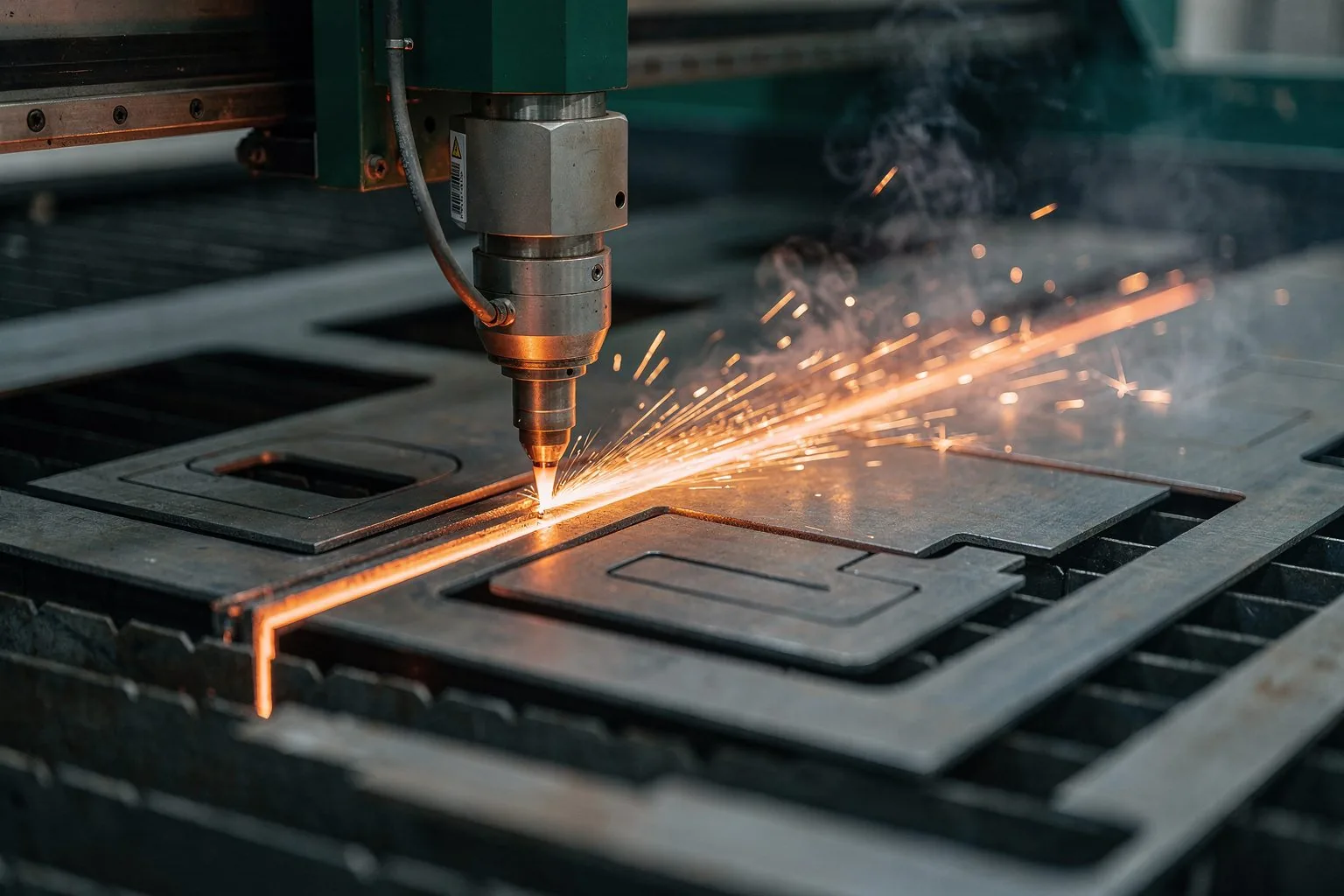
Fiber laser is the default — clean edges, minimal burr, no heat distortion in thin gauge, cuts reflective metals (aluminum, copper, brass) that CO₂ lasers struggle with. CNC turret punching for high-volume blanks, louvers, embossments, countersinks, and lances. Both processes happen before bending so features can be located against bend lines accurately. Tight nesting drives material yield up and per-part cost down on production runs.
CNC Press Brake Bending
Programmed bend sequences hold ±1° standard, ±0.5° tight. Multi-bend parts with 8–12 bends repeat without accumulated error.
MIG / TIG / Spot / Stud Welding
MIG for steel structurals, TIG for stainless and aluminum, spot for sheet-to-sheet, stud for blind-side fasteners. AWS-certified welders.
PEM Hardware Installation
Press-fit nuts, studs, standoffs, rivnuts, weld nuts. Installed after forming, before finishing — so plating covers the install zone.
Powder Coat / Plate / Anodize
Powder coat (RAL/Pantone), zinc, nickel, anodize, chromate, passivation, silk screen. See full finishing options →
Seven categories that cover most sheet metal work.
If your part starts as flat stock and needs cutting, bending, or welding — it falls into one of these.
Enclosures, Cabinets & Chassis
Electronics housings, telecom cabinets, server rack panels, industrial control enclosures, equipment chassis. Laser-cut, formed, welded, PEM-installed, powder-coated — ready to populate. Most include cutouts for connectors, displays, and ventilation.
Brackets & Mounts
L-brackets, Z-brackets, mounting plates, motor mounts, sensor brackets. Simple geometry, high volume, low cost per part.
Panels, Covers & Guards
Machine guards, access panels, equipment covers, decorative panels. Flat or formed with louvers, embossments, and cutouts.
Frames & Card Cages
Equipment frames, structural sub-assemblies, card cages with PEM hardware and threaded inserts. Welded or fastened.
Ductwork & HVAC
Rectangular and round duct sections, transitions, plenums. Formed and seam-welded in galvanized steel or stainless.
Bus Bars & Heat Sinks
Copper bus bars, EMI shields, ground planes, stamped/formed heat spreaders, RF shielding for electronics.
Prototypes & Pre-Production
One-off and low-volume prototypes — same fab process as production, no soft tooling required.
From thin-gauge electronics to heavy structurals.
Common gauges run from 24 ga (0.024", easily formed) through 10 ga (0.135", requires high tonnage). Heavier plate up to 1" available for structural work.
Steels
4 gradesAluminum & Non-Ferrous
5 gradesThreaded fasteners installed before finishing.
PEM hardware lets you bolt assemblies together without welding nuts or back-side access. Installed after forming, before powder coat — so the finish covers the install zone for corrosion protection.
PEM Press Nuts
Threaded inserts pressed into thin sheet — M3 to M10 metric, #4 to 3/8" UNC.
PEM Studs
Threaded studs for through-bolting components from the back side.
PEM Standoffs
Threaded spacers for mounting boards above the chassis surface.
Rivet Nuts (Rivnuts)
Threaded rivets for blind-side installation when back access is impossible.
Weld Nuts & Studs
Resistance-welded into heavier sheet for high-load fastening points.
Self-Clinching Fasteners
Permanent installation in ductile metals — flush front face, no back-side access.
Eight finish options coordinated with the cut and bend.
Sheet metal almost always ships finished — for corrosion protection, appearance, or both. We sequence finishing into the same PO as cut, bend, and weld.
Powder Coating
Durable, chip-resistant, UV-stable. Full RAL and Pantone range. Thickness 0.002–0.006". Indoor and outdoor.
Wet Paint
Custom color matching, multi-color graphics, small batches. Less durable than powder.
Zinc Plating
Low-cost corrosion protection for steel. Clear or yellow chromate. Brackets, fasteners, internal parts.
Nickel Plating
Better corrosion resistance than zinc. Provides EMI shielding on enclosures.
Anodizing (Aluminum)
Type II for color + corrosion. Type III hard coat for wear resistance.
Passivation (Stainless)
Removes free iron from laser-cut edges. Improves corrosion resistance per ASTM A967.
Chromate / Alodine
Conversion coating for aluminum — corrosion barrier and primer for paint adhesion. MIL-DTL-5541.
Silk Screen Printing
Permanent labels, logos, control panel markings, and identification on flat surfaces.
Six rules our DFM review catches most often.
Designing with these in mind saves you a prototype iteration. We flag every issue free of charge before quoting.
Add bend relief
Where a bend meets an edge or another feature. Without relief, the material tears or deforms. Relief width ≥ material thickness, length ≥ bend radius.
Hold holes off the bend line
Holes too close to the bend distort during forming. Minimum: 2.5× material thickness + bend radius from hole edge to bend line.
Mind the minimum flange
Flanges shorter than 4× material thickness slip out of the press brake die. Lengthen the flange or use a different forming method.
Bend perpendicular to grain
Bending across the grain is stronger and less likely to crack. Critical on stainless and high-strength aluminum (6061-T6 in particular).
Use tabs and slots for welding
Self-locating tab-and-slot joints reduce welding fixture cost and improve weld accuracy — especially on enclosures and frames.
Keep the bend radius consistent
Use the same inside bend radius across the part. Multiple radii require tooling changes — adds cost and time on every bend.
5 steps from RFQ to delivery.
Submit RFQ
Flat pattern (DXF) or 3D model (STEP) with material, gauge, quantity, finish, and hardware requirements.
DFM + Quote
Engineering review of bend feasibility, hole-to-bend distance, grain, hardware, nesting. Quote within 48–72 hours.
First Article
Fabricated through the full sequence: cut → bend → weld → hardware → finish. Inspected before production.
Production Run
Production per approved first article. In-process checks at each operation. Final inspection on dimensions, bend angles, hardware.
Finish + Ship
Powder coat / plate / paint, packaged to prevent scratching, delivered to your U.S. dock with inspection report and CoC.
Industries that depend on sheet metal
Sheet metal — answered.
What is the maximum sheet size you can process?
Standard fiber laser tables in our network handle 5 ft × 10 ft (1500 × 3000 mm) sheets. Press brakes go up to 12 ft (3600 mm) bend length. Larger formats are available on request — send your dimensions and we confirm feasibility within 48–72 hours.
Can you combine sheet metal with CNC machined features?
Yes. Some parts require flat sheet operations (cutting, bending) plus machined features (tapped holes, reamed bores, milled mounting surfaces). We coordinate both processes through our network and deliver a single finished part with one Certificate of Conformance.
Do you handle PEM hardware installation?
Yes — PEM press-fit nuts, studs, standoffs, rivnuts, weld nuts, and self-clinching fasteners. Hardware is installed after forming, before finishing, so plating or powder coat covers the installation area for corrosion protection.
What finishes are available for sheet metal?
Powder coating (most common, full RAL/Pantone), wet paint, zinc plating, nickel plating, anodizing for aluminum (Type II color or Type III hard coat), passivation for stainless, chromate/Alodine conversion coating, and silk-screen printing for labels and panel markings. Full options on the Surface Finishing page →
Can you weld aluminum?
Yes — TIG welding for aluminum 5052, 6061, and 3003. Requires clean material, proper fixturing, and experienced welders. We TIG-weld aluminum enclosures, frames, and structural assemblies through partner shops with certified welders (AWS D1.1 / D1.2 / D1.6 as required).
What are typical lead times?
2–4 weeks for standard cut-bend-weld jobs. Complex weldments, large assemblies, or finishing-heavy parts may take 4–6 weeks. Expedite available on most jobs — quoted on a per-project basis depending on partner capacity.
Do you operate your own machines, or do you use partner shops?
GPW operates a network of qualified sheet metal partner shops across Mexico — fiber laser cutting, CNC press brakes, MIG/TIG welding, PEM hardware installation, and finishing. We handle engineering review, supplier selection, quality control, and logistics. You never coordinate with the partner shop directly. One quote, one PO, one Certificate of Conformance from GPW.
Send us your flat pattern.
Material, gauge, quantity, finish, and hardware. We respond within 48–72 hours with pricing and a free DFM review — matched to the right sheet metal partner shop in our network.
No minimum order · NDA available · sales@gpw-solutions.com
Need a different process?
CNC Milling →
For machined features on a sheet metal part — tapped holes, reamed bores, precision mounting surfaces.
Surface Finishing →
All finishing options with specifications — powder, plating, anodize, passivation, chromate, silk screen.
Engineering Support →
Free DFM review — bend feasibility, hole-to-bend, grain direction, hardware, nesting.