Oil & Gas Machining — Engineered for Sour Service and Harsh Downhole Environments
Global Precision Works (GPW) coordinates precision machining of downhole tools, valve bodies, manifolds, and fittings in Inconel, Duplex, stainless 316, and PEEK — through a vetted Monterrey network, with NACE-compliant material sourcing, full traceability, and one accountable partner. Two hours from Texas.
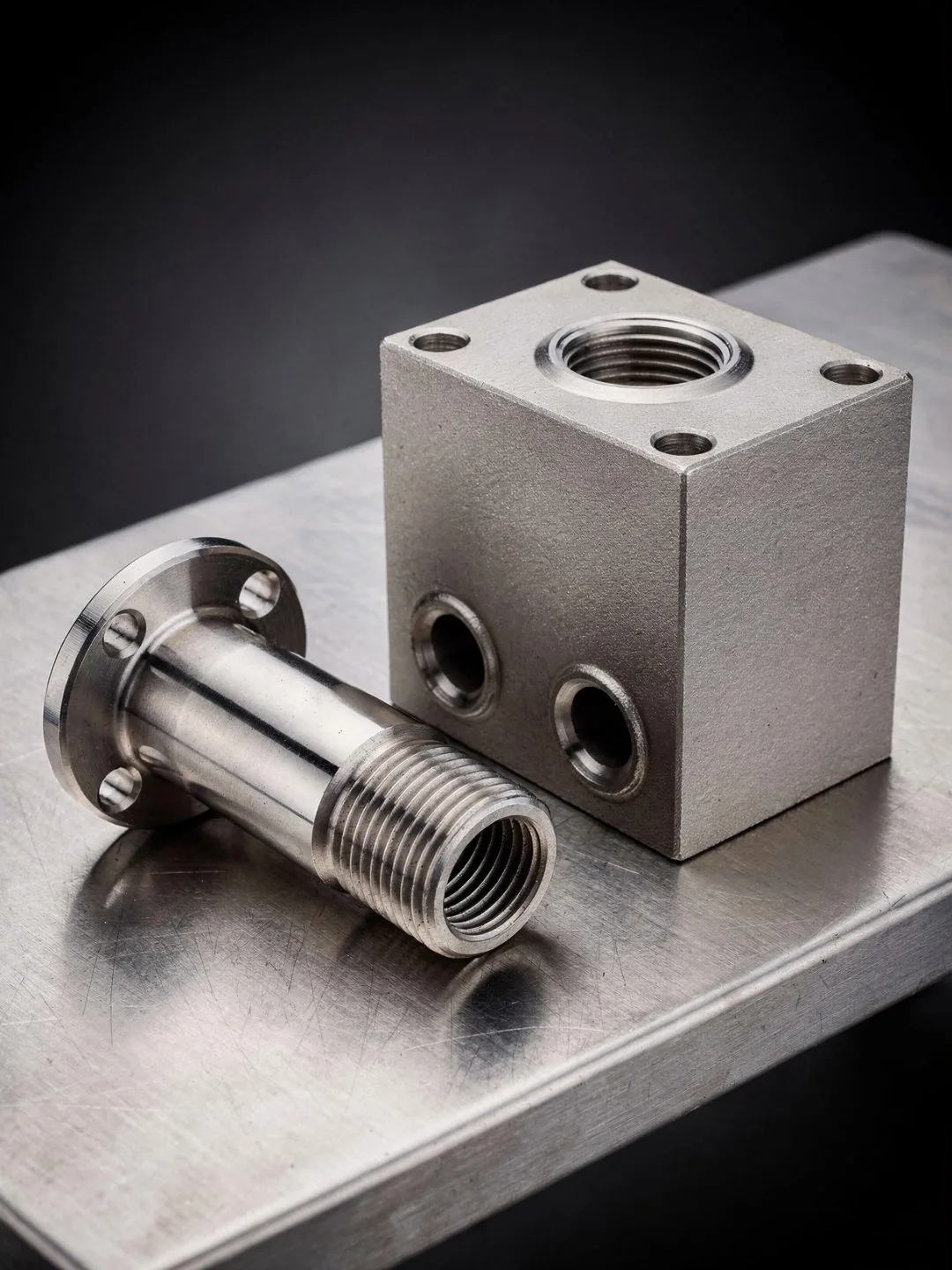
Oil and gas parts do not operate in a lab. They run a mile underground, submerged in seawater, or inside a pipeline carrying corrosive fluids at thousands of PSI — for years, without inspection access. A downhole failure is not a warranty claim. It is a workover rig at $50,000 a day and a fishing tool that may or may not retrieve the part. The material, the threads, and the sealing surfaces all have to be right the first time.
GPW coordinates the machining of those parts. Through a vetted network of Monterrey machine shops, GPW delivers downhole tools, valve bodies, manifolds, and fittings in corrosion-resistant alloys — while owning the engineering, NACE-compliant material sourcing, inspection, and on-time delivery. You work with one accountable partner, not a list of shops, and every part ships with full material traceability.
This is machining built for the oilfield. GPW knows that a non-compliant material in a sour-service well is a safety incident waiting to happen, that a scratch on a sealing diameter is a leak path, and that a rig at $50K a day does not wait 6 weeks for parts from Asia. The work is engineered to spec, documented to NACE and API requirements, and delivered close to the field.
What Is Oil & Gas CNC Machining?
Oil & gas CNC machining is the precision manufacturing of oilfield and downhole components — mandrels, subs, crossovers, valve bodies, manifolds, fittings, pump components, and wellhead hardware — cut from corrosion-resistant alloys such as Inconel, Duplex, stainless 316, and high-strength steels, to the dimensional and material standards that high-pressure, sour-service, and downhole environments demand. The work pairs tight tolerances and fine surface finishes on sealing surfaces with strict material control under NACE MR0175 and API specifications. GPW delivers it as a managed manufacturing partner: it coordinates a vetted network of Monterrey machine shops while owning the DFM, material sourcing, quality governance, and single-point delivery accountability — so the OEM gets traceable, spec-compliant parts from one company, not a pass-through broker.
Oilfield Demand Swings Hard — Your Machining Partner Has to Be Fast, Proven, and Close
Oil and gas is a cyclical, unforgiving business. When prices rise, operators ramp drilling and completion activity faster than the supply chain can respond; when they fall, volumes collapse. The machining partner that serves this sector has to scale capacity up and down without forcing the OEM to carry inventory between cycles — and has to be close enough to respond when a part is needed now, not in 2 months.
The parts themselves are unforgiving too. Standard steels corrode in weeks downhole. Sour-service environments containing H₂S cause sulfide stress cracking in susceptible materials, and NACE MR0175 / ISO 15156 defines which alloys survive and which fail. Using a non-compliant material is not a cost decision — it is a safety and liability exposure. Every part needs a complete Material Test Report proving chemistry, mechanical properties, heat treatment, and heat-lot traceability.
Continue reading Show less
Proximity is an operational advantage, not a convenience. Houston is the energy capital of the world, and Monterrey is a 1.5-hour flight or a 6-hour drive away. The Permian Basin — the most active drilling region in the western hemisphere — sits next door, roughly 6 hours by road from Monterrey. Parts can be on a truck Monday and on location Tuesday.
When a rig is down at $25,000 to $100,000 a day, the math changes. Offshore lead times of 8–12 weeks are not an option for downtime-critical parts. Same-timezone coordination means an operator’s procurement team calls at 10 AM and gets an answer at 10 AM — not a voicemail that waits until the next business day on the other side of the planet.
GPW is built for this. By coordinating a managed network of Monterrey machine shops and owning the engineering, material compliance, and delivery accountability, GPW delivers oilfield-grade machining at nearshore cost and speed — scalable for the upcycle, documented for the auditor, and close enough for the rig-down call.
What the Network Machines for Oil & Gas — Downhole, Valve, and Surface Components
GPW coordinates precision machining of oilfield and downhole components through a vetted network of Monterrey machine shops. GPW writes the DFM and process definition, sources NACE-compliant material, sets the inspection plan, and carries delivery accountability — so each part below is engineered, routed to the shop matched to its geometry and volume, and shipped under one part number with full documentation.
CNC Turning — The Dominant Process for Oil & Gas
Turning is the workhorse process for the sector. The network produces downhole mandrels, subs, adapters, crossovers, fittings, nozzles, couplings, valve stems, piston rods, and plungers — with API 5B threading (buttress, round, and line-pipe) and sealing surfaces finished to Ra 0.4 µm or better. Concentricity and runout are held tight on rotating components, and go/no-go gauging verifies every threaded connection.
A scratch on a sealing diameter is a leak path, so surface finish on sealing surfaces is treated as a functional requirement, not a cosmetic one — measured and recorded, not assumed.
CNC Milling — Valve Bodies, Manifolds, and Wellhead Components
Valve bodies, manifold blocks, pump housings, wellhead components, flange adapters, and choke bodies — with complex internal flow paths machined from solid billets of stainless, Inconel, Duplex, or high-strength steel. Large-envelope parts run on the network’s bigger machining centers; GPW confirms capacity for oversized work within 48–72 hours of an RFQ.
Wire EDM — Hardened, Stress-Free Profiles
Precision profiles in hardened components — seal geometries, keyways in hardened mandrels, and complex internal features in tool steel and carbide. EDM-cut surfaces carry no heat-affected zone and no residual stress, which matters for parts that have to survive sour service without becoming crack-initiation sites.
Surface Finishing — Corrosion and Wear Protection
Passivation per ASTM A967 on stainless components, electroless nickel plating as a corrosion barrier on steel parts, hard chrome on wear surfaces such as piston rods and plungers, and PTFE coating on valve seats and sealing surfaces. Finish is specified for the operating environment up front, not added as an afterthought.
Engineering Support — Free DFM for Exotic Alloys
Material selection for downhole conditions is its own discipline: which Inconel grade for this temperature and H₂S concentration, whether 17-4PH can replace Inconel at lower cost in a given environment, and how to reduce cycle time on alloys that cost $80 a pound. GPW’s free DFM review handles all of it before the first chip is cut.
From NACE Sourcing to the Field — Four Gates, One Accountable Partner
Every oilfield part GPW coordinates moves through the same four gates:
- 01 — NACE-verified sourcing. Compliance is settled before the first chip: mill cert in hand, with hardness limits, heat treatment, and chemistry confirmed against NACE MR0175.
- 02 — Turning and threading. The network cuts API 5B threads and finishes sealing surfaces to Ra 0.4 µm or better, holding the geometry a metal-to-metal seal needs at 15,000 PSI.
- 03 — Test and document. CMM verification with GD&T on critical features, hydrostatic testing through qualified partner facilities where the spec requires it, and an MTR package covering chemistry, mechanicals, heat lot, and the NACE compliance statement.
- 04 — To Houston, Midland, the field. Roughly 6 hours by truck to the Permian Basin, with same-day air freight when a rig is waiting.
Who This Is Built For — A Third Option Between Houston and Asia
You manage spend on downhole tools, fittings, and pump components for a mid-size service company. Your suppliers are mostly Houston and Asia. Houston is full and quoting weeks out. Asia is cheap, but the lead time leaves no margin for a rig-down emergency — an idle drilling rig burns $50,000 a day, and a platform deferring production loses $200,000.
GPW is built to be the third option: NACE-compliant, MTR-documented, and reachable in two hours by plane.
The Right Alloy, Certified Before the First Cut
Material selection in oil and gas is governed by the operating environment — pressure, temperature, and corrosion chemistry. The wrong material does not just fail; it fails catastrophically and expensively. GPW owns material sourcing and compliance behind the network, so the right alloy arrives certified before machining begins.
Materials the Network Machines for Oil & Gas
The network machines the full range of oilfield alloys, matched to service conditions:
- Stainless 316 / 316L — general corrosive service; NACE-compliant in most conditions
- Duplex 2205 — roughly twice the strength and chloride resistance of 316; subsea hardware and flowlines
- Super Duplex 2507 — high-chloride subsea, HPHT wells, and chemical-injection service
- Inconel 625 / 718 — wellhead and subsea connectors, downhole tools, and fasteners at depth; corrosion resistance plus strength at high temperature
- Titanium Grade 5 — lightweight, high-strength, seawater-immune components
- Steel 4340 — heat-treated to 180+ ksi with the toughness for drill collars, tool joints, subs, and high-stress structural hardware
- Steel 4140 — the lower-cost choice for lower-stress structural parts, surface equipment, and fixtures
- PEEK — 480°F continuous service and chemical resistance; backup rings, seals, insulators, and electrical connectors
- PTFE — chemically inert with the lowest friction of any oilfield polymer; valve seats, gaskets, and seal elements
GPW sources certified stock and matches alloy, temper, and finish to the well’s conditions during the free DFM review — see the full Metals and Plastics references for grades and properties.
NACE MR0175 / Sour-Service Compliance
Equipment for H₂S-containing (sour) environments is sourced per NACE MR0175 / ISO 15156. In practice that means maximum hardness limits (typically 22 HRC for carbon and low-alloy steels), specific heat-treatment requirements, controlled chemical composition, and full MTR documentation proving it.
GPW verifies NACE compliance at the material-sourcing stage — before machining begins, not after a part is already cut. A non-compliant material discovered downhole is a well-control event; caught at sourcing, it is a purchase-order correction.
Quality, Documentation & Accountability
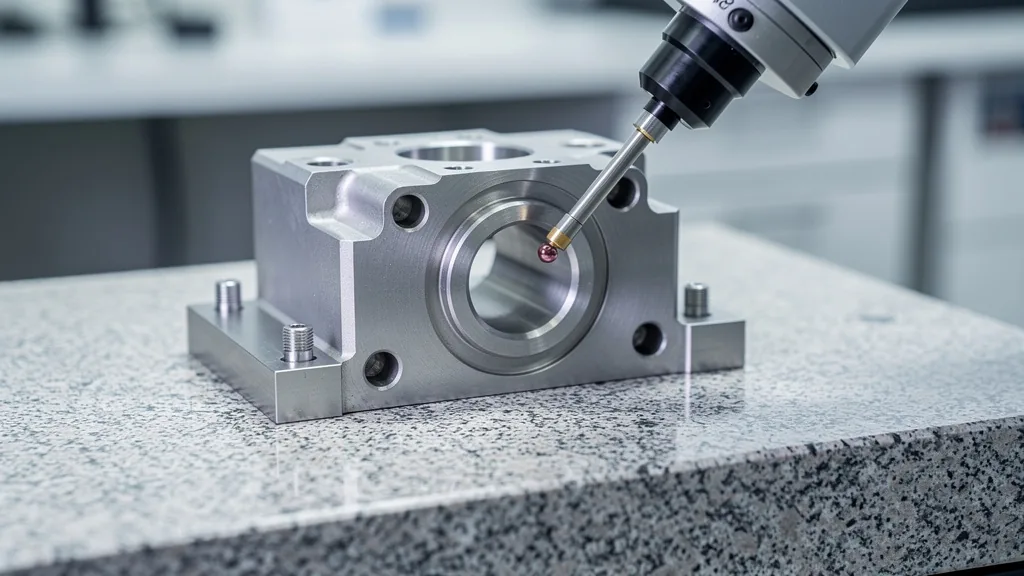
Quality governance stays with GPW across every shop in the network. GPW defines the inspection plan, runs dimensional verification with CMM reporting and GD&T callouts on critical features, gauges every API thread go/no-go, measures surface finish on sealing diameters, and assembles the documentation package — Material Test Reports, NACE compliance statements, inspection records, and heat-lot traceability from raw stock to finished part. One inspection standard applies no matter which shop cuts the part.
Every build follows documented workmanship and inspection standards, with first-article inspection, in-process checks, and full traceability. GPW aligns to the quality requirements each customer program defines — what GPW delivers today is documented, traceable, accountable machining under a single point of contact.
GPW responds to every RFQ within 48–72 hours with an initial program assessment. For rig-down emergencies, call directly — downtime-critical jobs are prioritized.
Get a Quote for Your Oil & Gas Machining Program Get a Quote for Your Oil & Gas Machining ProgramWhat a Typical Oil & Gas Machining Program Looks Like at GPW
Oil and gas machining programs share one trait: the part has to be right before it goes in the ground or in the line, because there is no second chance downhole. Here are three representative examples.
Downhole Tool Components
A U.S. oilfield-tool OEM produces a family of downhole mandrels, subs, and crossovers run in completion and intervention tools. Each part is turned from 4340 or Inconel 718, heat-treated to spec, threaded per API 5B, and finished on its sealing diameters to a controlled surface roughness.
GPW coordinates the full program: NACE-verified material sourcing, CNC turning and milling, heat treatment through qualified partners, thread gauging on every connection, and a documentation package with MTRs and dimensional records. Batches run on the OEM’s tool-build schedule, with expedited lanes held open for downtime-critical replacements.
Valve Bodies & Manifold Blocks
An OEM designs high-pressure valve bodies and multi-port manifold blocks for wellhead and surface production equipment. Each body is milled from solid billet in stainless 316, Duplex, or Inconel, with complex internal flow paths, machined seat pockets, and sealing surfaces that have to hold pressure without a leak path.
GPW coordinates milling, Wire EDM on hardened seat and seal features, passivation, and pressure testing through qualified partner facilities when the spec requires it. Every body ships pressure-test-ready with a full material and inspection record. Typical volumes: small-to-mid batches with material certified per NACE MR0175.
High-Volume Fittings & Adapters
An OEM produces couplings, nipples, reducers, and crossovers across a material range from carbon steel to Super Duplex. These are high-volume turned parts with API threading, where consistency across thousands of units is the whole game.
GPW routes the work to the network shop best matched to the volume and material, holds thread and dimensional consistency with go/no-go gauging and sampling plans, and keeps cost competitive through Monterrey labor rates. Material traceability follows every lot from heat to finished part.
Why Monterrey for Oil & Gas Machining — Cost, Proximity, and a Network That Flexes
Oil and gas buyers operate against two clocks: the commodity cycle that drives volume, and the rig-down clock that drives urgency. The machining partner you choose has to handle both — competitive cost on the steady work, and speed and proximity when a part is needed now.
Cost-Competitive Production
CNC labor in Monterrey runs roughly 60% below comparable U.S. shops — about $9 an hour fully fringed versus $25-plus in Houston. On high-volume turned and milled oilfield parts, that advantage compounds across the run. USMCA compliance adds preferential tariff treatment and North American content, with no Section 301 exposure.
Houston & Permian Proximity
Monterrey is a 1.5-hour flight from Houston and roughly 6 hours by road from the Permian Basin. Finished parts reach Texas and the Gulf Coast in 1-2 days by truck — not the 8-12 week ocean windows offshore requires. Expedited lanes stay open for downtime-critical parts when a rig is waiting.
Same-Timezone Coordination
Your buyer and engineering team work the same business hours as GPW. When a rig is down, the rig-down call is answered in real time — material substitutions, expedite decisions, and inspection questions resolve the same day, not on a 12-hour delay from the other side of the planet.
Scalable Network Capacity
Oilfield demand swings with the commodity cycle. The managed network flexes with it — ramping for the upcycle and scaling back between, with no single-shop bottleneck and no minimum-volume commitment that forces you to carry inventory through a downturn.
One Accountable Partner
GPW owns the DFM, NACE-compliant material sourcing, inspection plan, and delivery date across every shop in the network. You issue one purchase order and hold one company accountable for the result — a managed manufacturing partner, not a broker passing your job down the line.
Quality & Documentation Built for Oilfield Reliability
Oil and gas parts operate where inspection access is zero and failure is catastrophic. Quality is not a final gate — it is material compliance verified at sourcing, dimensions verified against the drawing, and a documentation trail that proves both. GPW governs all of it across the network.
NACE MR0175 Compliance
For sour-service parts, GPW sources materials per NACE MR0175 / ISO 15156 — hardness limits, heat treatment, and chemistry within defined limits — and verifies compliance before machining begins. Every sour-service lot ships with an MTR and a NACE compliance statement.
Material Test Reports (MTR)
Every shipment includes MTR documentation: actual chemical composition against spec, mechanical properties (tensile, yield, elongation, hardness), heat-treatment process, and heat-lot traceability linking the finished part back to its specific melt. If the material cannot be proven, the part does not ship.
Dimensional Inspection
CMM reporting with GD&T callouts on critical features, go/no-go thread gauging per API 5B on every threaded part, surface-finish measurement on sealing diameters, and concentricity and runout checks on rotating components. Inspection results travel with the parts.
API Standards Awareness
GPW machines to applicable API specifications — dimensions to drawing, threads per API 5B, and materials per API material groups. Where a spec calls for pressure testing, hydrostatic and pneumatic testing is coordinated through qualified partner facilities, with reports included in the package.
Lot Traceability
Every part is traceable to its heat lot and to the shop that machined it. GPW’s records link raw-stock certifications, inspection data, and finishing records to the individual lot — available for customer or end-operator audit at any time.
Certifications & Standards
- Documented workmanship and inspection standards — first-article inspection, in-process checks, and full traceability
- NACE MR0175 / ISO 15156 — sour-service material compliance with MTR documentation
- API 5B threading — go/no-go gauge verification on threaded connections
- ASTM A967 passivation — applied to stainless components per specification
- Customer-specific quality requirements accommodated through program-level quality plans
Oil & Gas
Machining FAQ
GPW coordinates a vetted network of Monterrey machine shops and owns the parts that matter to the buyer — the DFM and process definition, NACE-compliant material sourcing, the inspection plan, and single-point delivery accountability. GPW is the prime, quality-governing partner, not a broker that passes your job along. You issue one purchase order and hold one company accountable for the result.
Yes. Inconel 718 and 625, Hastelloy, Monel, Duplex, and Super Duplex. These materials demand rigid setups, ceramic or carbide tooling, slow speeds, and experienced operators — so GPW routes each job to the shop in the network with a proven exotic-alloy program for that geometry and volume.
Yes. GPW sources materials per NACE MR0175 / ISO 15156 with full Material Test Reports documenting chemical composition, mechanical properties, heat treatment, and heat-lot traceability. Compliance is verified at the sourcing stage — before machining begins, not after.
Yes. API 5B threading — buttress, round, and line-pipe connections — with go/no-go gauge verification on every threaded part. Thread inspection results are recorded in the documentation package that ships with the parts.
Expedited service is available for downtime-critical situations. Contact GPW directly by phone or email and your job is prioritized across the network. With Monterrey two hours from Texas, finished parts reach Permian Basin and Gulf Coast destinations in 1-2 days by truck.
Yes. Large-envelope valve bodies, manifold blocks, and wellhead components are machined on the network's larger mills and lathes. Send GPW your dimensions and material, and network capacity is confirmed within 48–72 hours.
Yes. Hydrostatic and pneumatic pressure testing is available through qualified partner facilities per your specification, with test reports included in the documentation package alongside MTRs, dimensional inspection records, and NACE compliance statements.
Ready to Machine Your Oil & Gas Parts Closer to the Field?
Whether you are sourcing downhole tools for the next completion run, valve bodies for a wellhead program, or high-volume fittings at a competitive cost — GPW is ready to quote.
Through a managed network of Monterrey machine shops, GPW delivers turned, milled, and EDM-cut oilfield components in NACE-compliant alloys — with the DFM, material traceability, and inspection documentation owned by one accountable partner, two hours from Texas.
Send us your material, pressure rating, environment, and documentation requirements. A program manager responds within 48–72 hours. For rig-down emergencies, call directly — we understand the urgency.
No commitment. No minimum order. Engineering-driven quoting.