Mechanical Precision Meets Electrical Reliability
Global Precision Works (GPW) brings together mechanical structures, electrical subsystems, cable routing, firmware, and system-level testing into a single production program — delivering fully validated products from Monterrey to your U.S. dock.
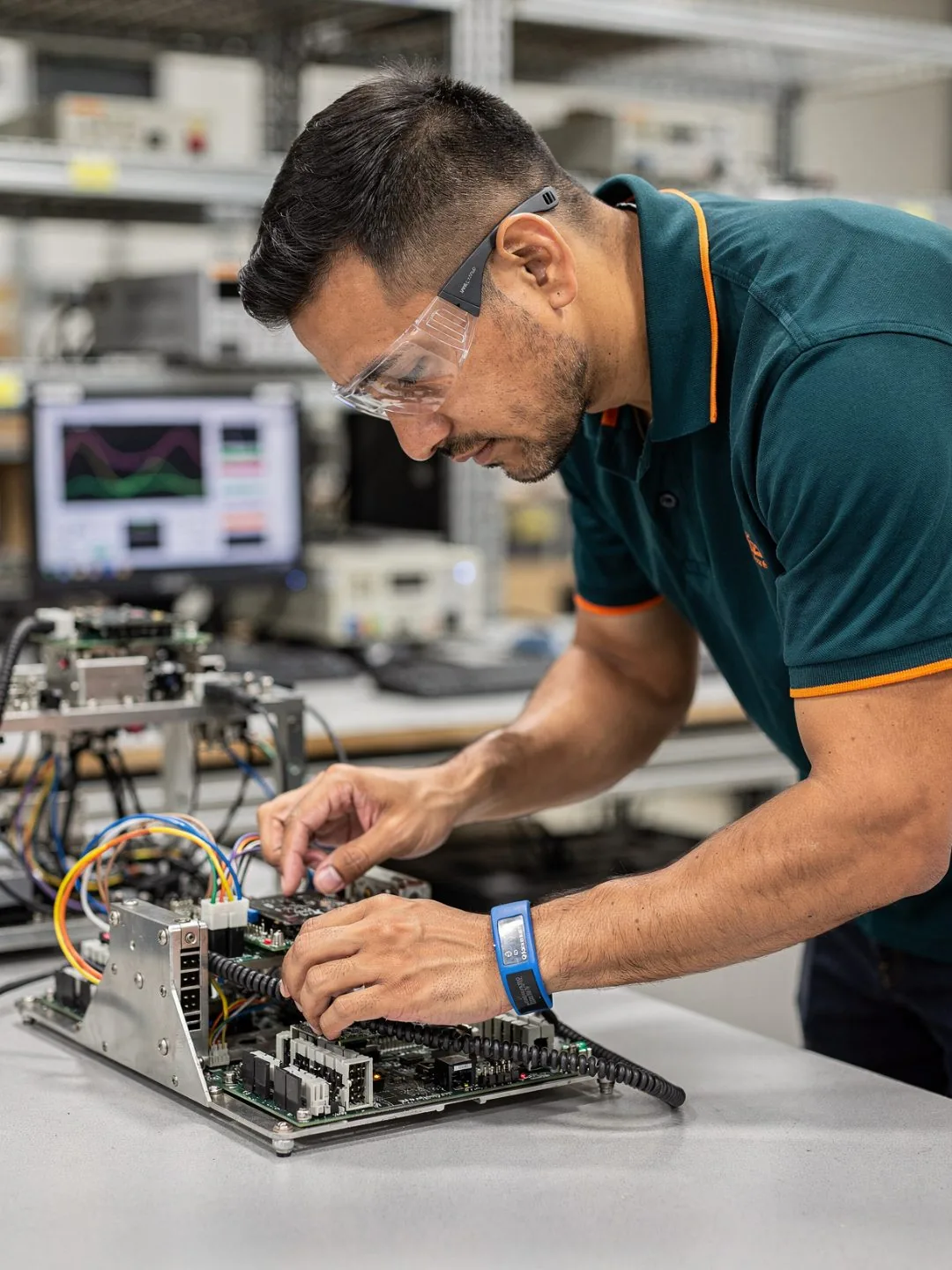
A product with 6 PCBAs, 2 power supplies, 14 cable assemblies, and 200+ discrete components does not fail because one board was soldered incorrectly. It fails because the subsystems were not integrated correctly — a cable harness pinched during mechanical assembly, a firmware version loaded onto the wrong board revision, or a thermal management path blocked by poor component placement.
Why GPW for System Integration
One facility, one quality system, one program manager. Mechanical, electrical, firmware, and testing converge on a single production floor — eliminating the subsystem handoff failures that plague multi-vendor programs.
What Is System Integration in Contract Manufacturing?
System integration in contract manufacturing is the process of combining multiple mechanical, electrical, and electromechanical subsystems into a single functional product — including structural assembly, component mounting, electrical interconnection, firmware loading, and system-level testing. Unlike board-level assembly (PCBA) or simple box build, system integration addresses the interactions between subsystems: how the power distribution feeds multiple boards, how the cooling system affects component placement, and how firmware versions must match specific hardware revisions.
An industrial automation OEM sends GPW the mechanical frame, control boards, motor drive assemblies, cable harnesses, sensor packages, and firmware images for a production control unit. GPW can also source any or all of these components — through its own supplier network, the customer's approved vendors, or a combination of both. GPW assembles the mechanical frame, mounts the boards and drives, routes and terminates all cabling, loads the correct firmware to each controller, runs a functional test that validates subsystem communication, and ships a finished unit packaged to the customer's logistics specifications.
Why This Matters for OEMs
System integration is not box build with extra steps. It is a fundamentally different engineering approach — one that considers the interactions between mechanical, electrical, and software subsystems from the first DFM review through final system-level validation. GPW operates as an assembly-first integrator: your program runs on a dedicated line in Monterrey, in the same timezone as your U.S. operations — available for real-time engineering collaboration without overnight email delays.
From Requirements to Validated System
Every system integration program at GPW follows a structured process. This is not a generic assembly workflow adapted for complex products. It is a purpose-built methodology designed for multi-subsystem products that require inter-discipline coordination.
Requirements Intake & Integration Planning
GPW's engineering team reviews the complete technical package: mechanical drawings, electrical schematics, cable routing diagrams, firmware specifications, and test requirements. The goal is to understand how the subsystems interact, not just how individual components are assembled.
This review produces an Integration Plan — a document that defines the assembly sequence, identifies subsystem interfaces, maps firmware version dependencies, and establishes the test protocol for system-level validation. If GPW's engineers identify design modifications that improve assembly efficiency or system reliability, those recommendations go back to the customer before the plan is finalized.
A documented Integration Plan with assembly sequence, subsystem interface map, firmware deployment protocol, and procurement responsibilities.

Mechanical & Electrical Subsystem Assembly
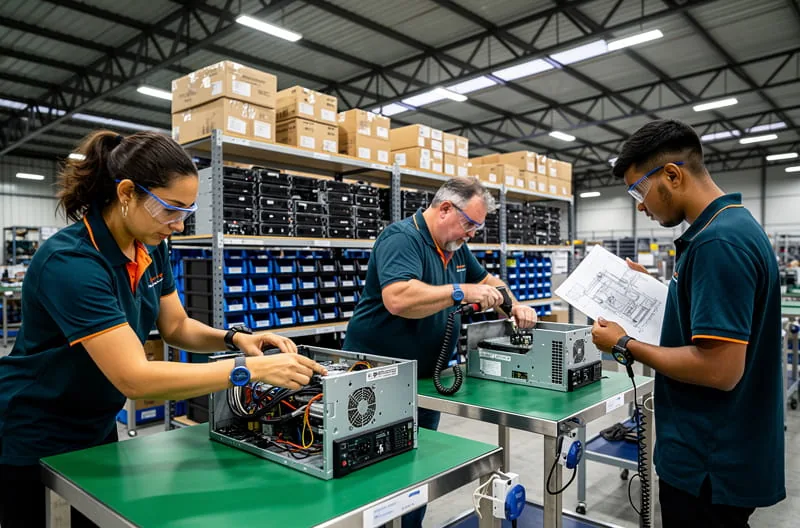
Mechanical and electrical assembly happen in coordinated stages — not sequentially. The mechanical frame goes up first, then electrical subsystems are integrated in the sequence defined by the Integration Plan. This staged approach prevents the most common integration failure: assembling mechanical structures that block access to electrical mounting points or cable routing paths.
Operators work from visual work instructions displayed at each station. Every fastener torque, cable termination, and component placement is documented. The work instructions reference specific drawing revisions and BOM line items — eliminating ambiguity about which hardware version is being built.
A mechanically and electrically complete assembly, ready for firmware and system-level validation.
Firmware Loading & Configuration
Firmware loading in a multi-board system is not a single-step process. Each controller, processor, or programmable device may require a different firmware image, a specific loading sequence, and configuration parameters that depend on the hardware revision and the end-customer's requirements.
GPW maintains version-controlled firmware repositories for each program. The loading protocol specifies which firmware version goes on which board, the correct loading sequence, post-load verification checks, and configuration parameters. Firmware mismatches — loading Rev 2.1 firmware onto a Rev 3.0 board — are caught by the protocol before the system reaches testing.
For programs that require it, GPW supports serialized firmware deployment: each unit receives a unique configuration tied to its serial number, logged in the production record.
Every board in the system carries the correct firmware version, verified and documented.
System-Level Testing & Validation
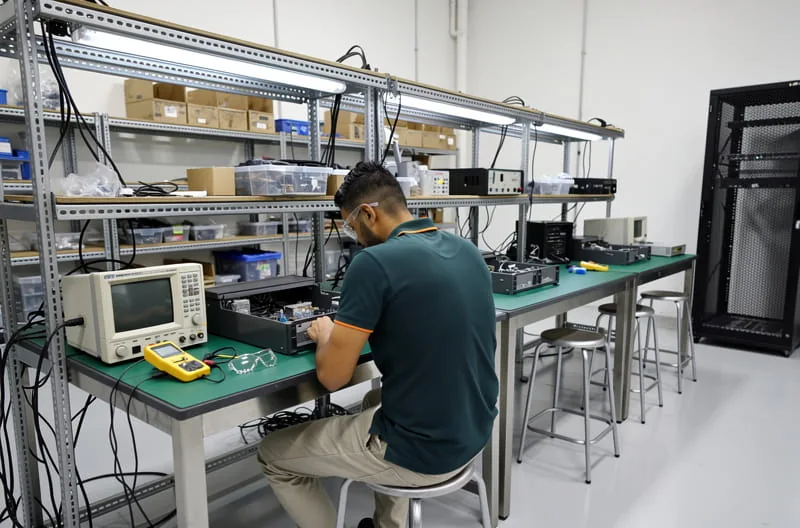
System-level testing validates what component-level testing cannot: that the subsystems work together as designed. A board that passes its own functional test may fail when communicating with other boards through the backplane. A cable harness that tests clean on a continuity checker may introduce noise when routed next to a high-frequency signal path.
GPW designs test protocols specific to each product. The test plan covers power sequencing, subsystem communication verification, functional performance under load, thermal behavior, and safety compliance. For programs that require it, GPW runs burn-in testing under sustained load to identify early-life failures before the product ships.
If a unit fails any test, technicians route it to a dedicated diagnostic station. The failure is analyzed at the system level — not just the component level — because integration failures often present symptoms on one subsystem while originating in another.
A fully validated system with documented test results for every functional parameter.
Final Inspection, Packaging & Shipment
The final stage covers cosmetic inspection, labeling, serialization, and packaging. GPW configures packaging for each program: ESD-safe materials for sensitive electronics, custom foam inserts for shock protection during transit, multi-unit palletization for volume shipments, and customer-branded packaging when required.
USMCA-compliant documentation ensures duty-free entry into the U.S. for qualifying products. For programs requiring direct-to-customer shipment, GPW coordinates logistics from Monterrey to U.S. destinations, with transit times of 1-3 days to major U.S. markets.
Finished systems arrive at your dock ready for deployment — tested, documented, and packaged to your specification.

Your Technical Package. Our Integration Expertise.
One Validated System.
Submit your mechanical drawings, electrical schematics, BOM, and test requirements. GPW's engineering team responds within 2 business days with an Integration Plan outline and preliminary timeline.
Request a Quote Request a QuoteIndustries That Use System Integration
System integration is the most complex service GPW offers. It applies wherever a product combines multiple subsystems that must function together — not just sit inside the same enclosure.
The same integration methodology applies across all verticals — the compliance requirements and test protocols adjust to each industry's standards. Multi-vertical expertise means solutions developed for aerospace traceability improve the quality baseline for industrial equipment programs, and firmware management protocols from AI server builds strengthen every integration line.
What Does GPW's System Integration Capability Include?
- Products ranging from 3 to 20+ subsystems per unit
- Multi-board systems with up to 12 PCBAs per assembly
- Cable assemblies from AWG 30 signal wiring to AWG 4 power distribution
- Firmware loading across multiple controller architectures (ARM, x86, FPGA)
- System-level test protocols with 20 to 100+ test points per unit
- Documented workmanship and inspection standards across every build
- Serialized build records with full component traceability
- Integration-specific quality gates at each subsystem handoff
- Documented test results archived per unit serial number
- Aligned to the documentation and inspection requirements each customer program defines
- GPW-sourced components through established supplier network
- Customer-directed procurement through approved vendor lists
- Customer-furnished materials with incoming inspection
- Hybrid models combining all three approaches per BOM line item
System integration is where subsystem assumptions become system-level facts. GPW validates that boards communicate, firmware matches hardware revisions, and the complete system performs under load — not just individual components in isolation.
GPW vs. Typical PCBA-Centric EMS
| Aspect | Typical PCBA-Centric EMS | GPW (Assembly-First) |
|---|---|---|
| Integration planning | Generic assembly work instructions | Dedicated Integration Plan per product |
| Firmware management | Manual firmware loading, limited version tracking | Version-controlled repository with per-unit deployment records |
| Testing scope | Component-level testing only; system test by customer | System-level validation across all subsystems |
| Engineering focus | Shared engineers across SMT lines and assembly | Full-time integration engineers assigned to your program |
| Subsystem coordination | Sequential: build mechanical, then wire, then test | Staged mechanical-electrical build sequence |
| Failure analysis | Component-level troubleshooting; integration issues returned to customer | System-level root cause analysis across subsystems |
The difference comes down to design intent. A PCBA-centric provider treats integration as an add-on to its board fabrication business. GPW treats integration as the core discipline. The engineering team, production floor layout, and quality systems are organized around building complete products, not individual boards. When an issue surfaces at system test, the same engineers who designed the integration sequence analyze the failure, trace it to the root cause, and implement the corrective action — all within the same facility, on the same shift.
System integration programs at GPW draw on the full multi-vertical expertise of the facility. Cable and wire harness assemblies built to documented workmanship standards feed directly into the integration line. End-of-line testing and inspection follows protocols engineered for the specific product. Enclosure and cabinet assembly provides the mechanical structures that house integrated subsystems. Every supporting service operates under the same roof, the same quality system, and the same program management.
System
Integration FAQ
System integration combines multiple mechanical, electrical, and electromechanical subsystems into a finished product. It includes structural assembly, component integration, cable routing, firmware loading, and system-level testing. GPW manages the full scope from NPI through production under one quality system in Monterrey.
Box build assembles components into an enclosure. System integration goes further — it addresses subsystem interactions, firmware dependencies, and system-level validation. A box build puts boards in a chassis. System integration ensures those boards communicate, the firmware matches the hardware revision, and the complete system performs under load.
Yes. GPW maintains version-controlled firmware repositories for each program. The loading protocol specifies which image goes on which board, the correct sequence, post-load verification, and configuration parameters. Serialized deployment — unique configuration per unit serial number — is available for programs that require it.
Typical NPI for system integration programs runs 4-8 weeks from approved Integration Plan to first article completion. Complex programs with 10+ subsystems or custom test development may require additional time. GPW provides a detailed NPI timeline during the quoting process.
A quote covers integration planning, mechanical and electrical assembly, firmware loading, system-level testing, documentation, and packaging. Component procurement is quoted separately based on the sourcing model — GPW-sourced, customer-directed, or customer-furnished.
Every build follows documented workmanship and inspection standards, with first-article inspection, in-process checks, and full serialized traceability. We align to the documentation, traceability, and inspection requirements each customer program defines.
GPW supports integration programs from prototype quantities through sustained production runs. The production floor accommodates dedicated integration lines that scale with your program volume. Whether you need 10 units for qualification or 500 units per month for production, the same quality system and integration methodology apply.
Start Your System Integration Program
System integration requires detailed planning — and that planning starts with your technical package. Submit your mechanical drawings, electrical schematics, BOM, firmware specifications, and test requirements. GPW's engineering team reviews every program and responds within 2 business days with an Integration Plan outline and preliminary timeline.
Request a Quote Request a QuoteNo minimum order quantities. Programs from prototype through production volume. Engineered for your timeline.