
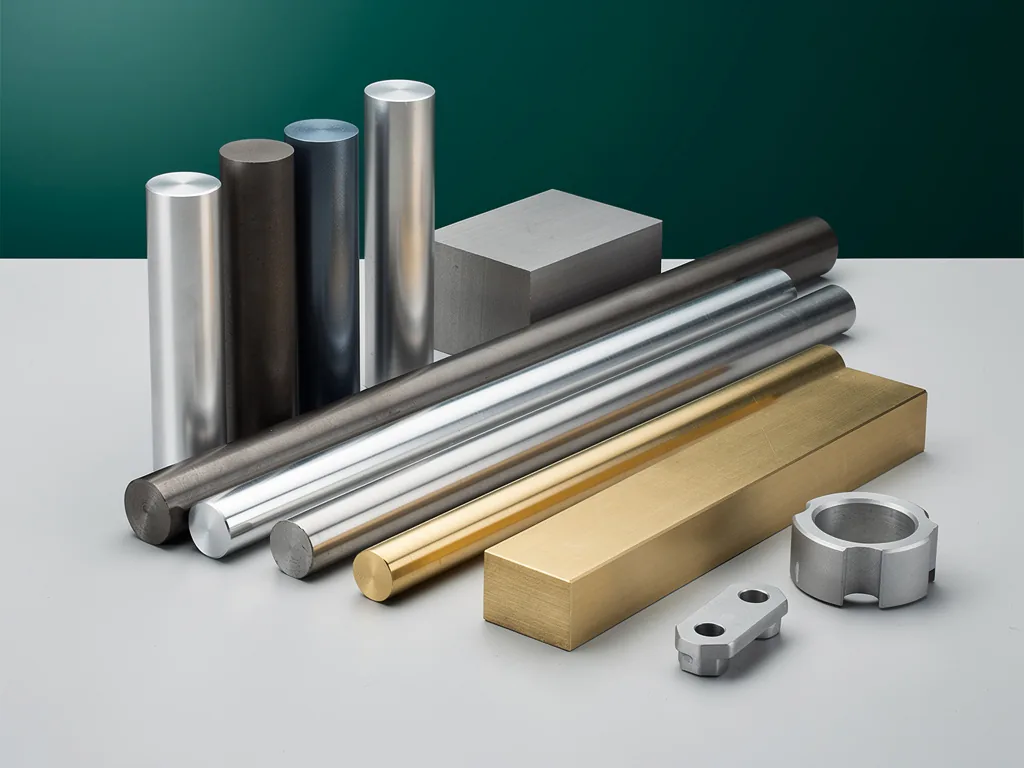
Engineering metal bar stock and machined samples
Contract Manufacturing — Materials Reference

Metals for CNC Machining —
Grades, Properties, Applications

We machine aluminum, steel, stainless, titanium, brass, copper, bronze, and tool steel — each in multiple grades optimized for different applications. Not sure which metal is right? Our engineers recommend the best option during your free DFM review.

Metals8 Families
GradesMultiple
ReviewFree DFM
7Metal Families
25+Grades In Stock or Sourced
Mill CertsOn Every Shipment Available
Customer SupplyOK — We Machine What You Send
The Right Metal for the Job

The metal you choose determines how your part performs, how long it lasts, how much it costs to machine, and how much it costs to buy. Over-specifying wastes money. Under-specifying causes failures.

Match the Material to the Application

Two parts that look identical on a drawing can cost 3× different depending on the material. Aluminum 6061 machines in half the time of stainless 316 and costs a third as much per pound. But if your part lives in a saltwater environment, 6061 corrodes in months while 316 lasts decades.

The goal is matching the material to the application — not picking the most expensive option and not picking the cheapest. Not sure which metal is right? Upload your part and tell us your application. Our engineering team recommends the best material at no charge. → Engineering Support

~40% of all CNC jobs

Aluminum Alloys

The most commonly machined metal. Lightweight, corrosion-resistant, excellent machinability, available in dozens of alloys for different applications.

Aluminum 6061-T6

The Default

The default aluminum for CNC machining. If you are not sure which aluminum to specify, start here.

Tensile Strength45,000 PSI (310 MPa)
Yield Strength40,000 PSI (276 MPa)
Hardness95 HB
Density0.098 lb/in³ (2.70 g/cm³)
MachinabilityExcellent
WeldabilityGood
Best for: General-purpose structural parts. Brackets, housings, mounting plates, frames, fixtures, heat sinks, enclosures.
Industries: All sectors
Finishing: Anodize Type II/III, powder coat, chem film, bead blast.

Aluminum 7075-T6

High Strength

Use when 6061 is not strong enough and steel is too heavy.

Tensile Strength83,000 PSI (572 MPa)
Yield Strength73,000 PSI (503 MPa)
Hardness150 HB
Density0.101 lb/in³ (2.81 g/cm³)
Corrosion ResistanceFair (anodize required)
WeldabilityPoor — avoid welding
Best for: High-stress structural where weight matters. Aerospace brackets, fittings, ribs. Tooling plates. Sporting goods.
Industries: Aerospace, defense, sporting goods
Cost note: 7075 costs 2–3× more than 6061 per pound. Specify only when strength justifies it.

Aluminum 2024

Fatigue-Rated

Developed for aircraft structures that see repeated loading cycles.

Tensile Strength68,000 PSI (469 MPa)
Fatigue StrengthSuperior to 6061 / 7075
Corrosion ResistancePoor — needs cladding
MachinabilityGood
Best for: Aircraft fuselage skins, wing ribs, fatigue-critical structural members. Not a general-use grade.
Industries: Aerospace

Aluminum 5052

Marine / Sheet

The formability and corrosion champion. Best aluminum for sheet metal applications and marine environments.

Tensile Strength33,000 PSI (228 MPa)
Corrosion ResistanceExcellent — best of the family
FormabilityExcellent — bends without cracking
MachinabilityGood
Best for: Sheet metal enclosures, marine hardware, fuel tanks, chemical containers.
Industries: Marine, industrial, sheet metal

Aluminum 6063

Best Anodize Finish

Machines to a smoother finish than 6061 and anodizes with a more uniform appearance.

Tensile Strength35,000 PSI (241 MPa)
Corrosion ResistanceExcellent
Surface FinishSuperior anodize quality
MachinabilityGood
Best for: Architectural parts, cosmetic enclosures, complex heat sink fins (often extruded then CNC-machined).
Industries: Electronics, consumer, architectural
The Industrial Workhorse

Steel Alloys

Strong, tough, heat-treatable, and available in hundreds of grades. Heavier than aluminum but significantly stronger.

Steel 1018 (Mild / Low Carbon)

Default Low-Cost

Easy to machine, easy to weld, readily available.

Tensile Strength63,000 PSI (440 MPa)
Hardness126 HB (as-rolled)
MachinabilityExcellent
WeldabilityExcellent
Heat TreatmentCase hardenable only
Best for: Non-critical structural parts, pins, shafts, spacers, fixtures, jigs, custom fasteners.
Industries: Industrial, automotive, general

Steel 4140 (Alloy)

Heat-Treatable Alloy

The medium-carbon alloy steel for parts that need real strength.

Tensile Strength95K annealed / 150K+ HT
Hardness197 HB / 50+ HRC HT
MachinabilityGood (annealed)
WeldabilityFair — preheat required
Heat TreatmentThrough-hardenable
Best for: Gears, shafts, axles, connecting rods, tooling, heavy-duty structural.
Industries: Automotive, oil & gas, industrial

Steel 4340 (Alloy)

Highest Strength Common Steel

When 4140 is not enough.

Tensile Strength108K annealed / 180K+ HT
Fatigue StrengthSuperior to 4140
ToughnessExcellent
MachinabilityFair — harder than 4140
Best for: Landing gear, crankshafts, high-stress aerospace fasteners, drill collars, tool joints.
Industries: Aerospace, defense, oil & gas
Cost note: More expensive than 4140 and slower to machine. Use when fatigue or impact loading requires it.

Steel A36 (Structural)

Cheapest Common Steel

Low-cost structural steel for non-precision parts.

Tensile Strength58,000–80,000 PSI
MachinabilityGood
WeldabilityExcellent
Best for: Structural brackets, weldments, base plates, non-precision parts. Often used for welded frames.
Industries: Construction, industrial, fabrication
10.5%+ Chromium

Stainless Steel

Resists corrosion through chromium content. Different grades balance machinability, strength, and corrosion resistance differently.

Stainless 303

Fastest-Cutting Stainless

Added sulfur makes it the fastest-machining stainless grade.

Tensile Strength85,000 PSI
MachinabilityBest of any stainless
Corrosion ResistanceGood (less than 304/316)
WeldabilityPoor — not recommended
Best for: High-volume turned parts where machinability drives cost. Fittings, fasteners, shafts, valve stems, nuts.
303 vs 304: When you do not need to weld and corrosion is not severe. 2–3× faster.

Stainless 304

The Default Stainless

The most widely used stainless. The default when someone says "stainless steel."

Tensile Strength75,000 PSI
Corrosion ResistanceExcellent
WeldabilityExcellent
MachinabilityFair — work-hardens
Best for: Food and beverage equipment, medical devices, chemical handling, kitchen, outdoor hardware.
Industries: Medical, food, pharma, industrial

Stainless 316

Corrosion Champion

When 304 is not enough.

Tensile Strength75,000 PSI
Corrosion ResistanceSuperior — chlorides + acids
MachinabilityFair (similar to 304)
Cost20–30% more than 304
Best for: Marine hardware, chemical processing, pharmaceutical, surgical instruments, chloride or acid exposure.
Industries: Medical, marine, pharma, chemical
316 vs 304: Marine/saltwater, chloride or acid exposure, pharma/medical where pitting is unacceptable.

Stainless 17-4PH

Strongest Common Stainless

Precipitation-hardened — heat-treat to high hardness while retaining corrosion resistance.

Tensile StrengthUp to 190,000 PSI (HT)
HardnessUp to 44 HRC
Corrosion ResistanceGood (better than 410)
MachinabilityFair (machine, then HT)
Best for: Aerospace fasteners, valve components, gears, shafts, pump components.
Industries: Aerospace, oil & gas, medical, defense

Stainless 440C

Hardest Common Stainless

Hardens to 58–60 HRC — comparable to tool steel.

Hardness58–60 HRC heat-treated
Corrosion ResistanceModerate
MachinabilityAnnealed, then harden
Best for: Bearings, valve seats, bushings, cutting edges, wear surfaces. Wire EDM after hardening for tight tolerances.
Industries: Medical (instruments), industrial
Highest Strength-to-Weight

Titanium

Highest strength-to-weight ratio of any structural metal. Biocompatible, corrosion-immune, and expensive.

Titanium Grade 2 (CP)

Commercially Pure
Tensile Strength50,000 PSI
Density0.163 lb/in³ (60% of steel)
Corrosion ResistanceExcellent — virtually immune
BiocompatibilityYes — ISO 10993
MachinabilityModerate — sharp tooling
Best for: Chemical processing equipment, marine hardware, non-structural medical implants. Corrosion immunity over strength.
Spec: Sourced per ASTM F67

Titanium Grade 5 (Ti-6Al-4V)

The Workhorse Alloy

The most-used titanium alloy — 60% of all titanium production goes here.

Tensile Strength130,000 PSI (900 MPa)
Density0.160 lb/in³ (4.43 g/cm³)
Corrosion ResistanceExcellent
BiocompatibilityYes — orthopedic standard
MachinabilityDifficult — work-hardens
Best for: Aerospace structural components, medical implants (hip, knee, spinal), fasteners, engine parts. Steel strength at 60% the weight.
Spec: ASTM F136 (ELI for implants)
Cost note: 10–20× more per pound than aluminum 6061 and machines 3–5× slower. Specify only when the application demands it.
Conductivity & Bearings

Copper, Brass & Bronze

For electrical conductivity, thermal conductivity, fast turning, or self-lubricating bearings — this family covers them all.

Brass 360 (Free-Machining)

Fastest-Machining Common Metal

The fastest-machining common metal. Period.

Machinability100 (the baseline)
Electrical Conductivity26% IACS
Corrosion ResistanceGood
Best for: Fittings, valves, connectors, electrical terminals, plumbing components, decorative hardware. Thousands of turned parts fast and cheap.
Industries: Plumbing, electrical, automotive

Copper 101 (OFHC)

Conductivity Champion

The electrical and thermal conductivity champion.

Electrical Conductivity101% IACS
Thermal Conductivity226 BTU/hr·ft·°F
MachinabilityFair — soft, gummy
Best for: Bus bars, heat sinks, waveguides, electrical contacts. Maximum electrical or thermal conductivity.
Industries: Electronics, telecom, electrical

Copper 110 (ETP)

General Electrical

Electrolytic Tough Pitch — common, less expensive than 101.

Electrical Conductivity100% IACS
AvailabilityMore common than 101
Best for: General electrical components, connectors, terminals. Use when 101's oxygen-free purity is not required.
Industries: Electronics, electrical

Bronze 932 (SAE 660)

The Bearing Material
Bearing PropertiesSelf-lubricating
Compressive Strength30,000 PSI
MachinabilityGood
Best for: Bushings, bearings, thrust washers, wear plates, slide pads. Runs against hardened steel without galling.
Industries: Industrial, automotive, marine
Dies, Molds & Tooling

Tool Steel

Designed for making tools — dies, molds, punches, gauges. Machined annealed, then hardened, then finished by grinding or wire EDM.

58–62 HRC

D2

High wear resistance, air-hardening. The most common die steel. Best for: Blanking dies, forming dies, punches, slitter knives.

57–62 HRC

A2

Good toughness/wear balance, air-hardening. Less brittle than D2. Best for: Punches, dies, tooling where toughness matters.

44–52 HRC

H13

Hot-work steel, retains hardness at elevated temps. Best for: Die casting dies, extrusion tooling, hot forging dies, injection mold cores.

54–58 HRC

S7

Shock-resistant, highest impact toughness. Best for: Chisels, punches, shear blades, impact tooling. When the tool takes hits.

57–62 HRC

O1

Oil-hardening, fine grain, excellent dimensional stability. Best for: Gauges, jigs, fixtures, precision tooling, taps, reamers.

Quick Reference

Metal Selection Guide

Cannot decide? Match your need to the recommended metal — or send us your part and we recommend at no charge.

Your Need
Recommended
Why
General-purpose lightweight
Aluminum 6061-T6
Best all-around: strong, machinable, affordable
Maximum strength (lightweight)
Aluminum 7075-T6
Near-steel strength at 1/3 the weight
General-purpose steel
Steel 1018
Cheap, easy to machine, easy to weld
High-strength steel
Steel 4140 / 4340
Heat-treatable, tough
Corrosion resistant (standard)
Stainless 304
Handles most environments
Corrosion resistant (harsh)
Stainless 316
Chlorides, acids, marine
High strength + corrosion
Stainless 17-4PH
When you need both
Maximum machinability (stainless)
Stainless 303
2–3× faster than 304
Lightweight + biocompatible
Titanium Grade 5
Aerospace, medical implants
Electrical conductivity
Copper 101 / 110
Highest conductivity available
Fast high-volume turning
Brass 360
Fastest machining metal
Bearings and wear surfaces
Bronze 932
Self-lubricating
Tooling and dies
D2, A2 or H13
Depends on application temp and impact
FAQ

Common Questions About CNC Machining Metals

What is the most commonly requested metal?

Aluminum 6061-T6 — approximately 40% of all CNC machining projects. It is the default choice when the application does not specifically demand something else.

Which metal is cheapest to machine?

Brass 360 and aluminum 6061 are the fastest and cheapest to machine. Steel 1018 is the cheapest steel option. Stainless 303 is the cheapest stainless option per cycle time.

Can you machine hardened steel?

Yes — via wire EDM. Conventional machining of hardened steel (above 45 HRC) destroys cutting tools. The typical approach: machine in annealed state → heat treat → finish critical features by EDM or grinding. → Wire EDM

Do you stock materials, or do we supply?

We source materials from verified suppliers with full material certifications (mill certs). You can also supply your own material — we machine what you send.

Can you provide material certifications?

Yes. Every shipment can include mill certifications showing chemical composition, mechanical properties, and heat lot traceability. Standard for aerospace, medical, and oil & gas projects.

Request a Quote

Tell us your material, quantity, and tolerances. If you are not sure which metal is right, tell us your application — our engineering team recommends the best option at no charge.

Mill certs available · Customer-supplied material accepted · [email protected]

Need plastics instead of metals?

PEEK, Delrin, nylon, PTFE, polycarbonate — the engineering plastics catalog covers chemical resistance, biocompatibility, low friction, and high-temperature service applications.

See Plastics Catalog See Plastics Catalog