Plastics for CNC Machining —
Engineering-Grade Materials
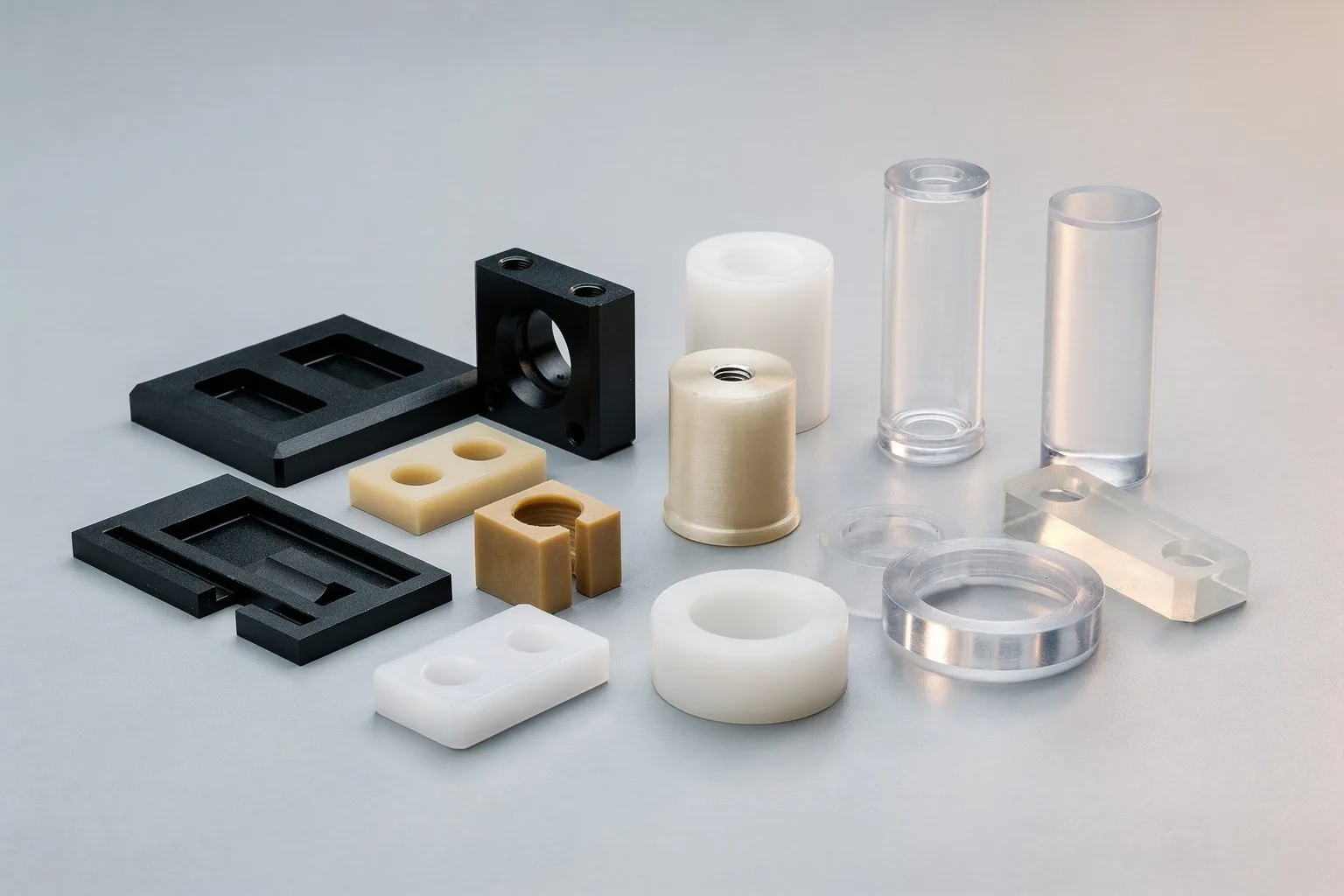
PEEK, Delrin, nylon, PTFE, polycarbonate, and a dozen more engineering plastics — machined to precision tolerances from Monterrey, Mexico. Not sure which plastic fits your application? Our engineers recommend the best option during your free DFM review.
Engineering plastics replace metal in applications where you need lighter weight, chemical resistance, electrical insulation, or biocompatibility — without sacrificing structural performance.
Why CNC Machine Plastics?
CNC machining is the right process for plastic parts when quantity is low to medium (under 500 parts, machining beats molding because there is no tooling investment), tolerances are tight (machining holds ±0.002", molding holds ±0.005"), material is expensive (PEEK at $50–150/lb — rod stock wastes less than molding), or the design is still evolving.
CNC Machining vs Injection Molding
When to use which — the honest comparison.
500–5,000 parts? It depends on geometry, material, and tolerance. Upload your part and we will recommend the right process.
High-Performance Engineering Plastics
These materials compete with metals. They cost more, machine slower, and require experienced operators — but they deliver properties no metal can match in certain applications.
PEEK (Polyether Ether Ketone)
The Highest-PerformingIf you could only have one engineering plastic, this is the one.
- Standard PEEK — Unfilled, best for biocompatible and chemical applications
- 30% Glass-Filled PEEK — Higher stiffness, better dimensional stability, reduced thermal expansion
Delrin / Acetal (POM)
The Engineer's FavoriteMachines like butter, holds tight tolerances, and costs a fraction of PEEK.
- Delrin 150 (Standard) — Best all-around. Use as the default.
- Delrin AF (PTFE-filled) — Lowest friction. For bearings and slides.
- 30% Glass-Filled Delrin — Highest stiffness and dimensional stability.
Nylon 6/6
Takes a BeatingStrong, tough, and abrasion-resistant.
- Standard Nylon 6/6 — General purpose
- 30% Glass-Filled Nylon — Higher stiffness, lower moisture (0.9%)
PTFE / Teflon
Lowest Friction, Most InertThe lowest-friction, most chemically inert solid material available.
General-Purpose Plastics
Common applications at lower cost than the high-performance group. Suitable for most non-extreme environments.
Polycarbonate (PC)
Virtually UnbreakableABS
Prototype WorkhorseAcrylic (PMMA)
Best Optical ClarityUHMW-PE
Abrasion ChampionUltra-High Molecular Weight Polyethylene.
PVC (Polyvinyl Chloride)
Chemical Resistant, CheapSpecialty & High-Temperature Plastics
When the application has unusual requirements — high temperature, flame retardancy, electrical insulation, or extreme wear.
Ultem / PEI (Polyetherimide)
Aerospace-GradeGarolite G-10
Glass-Epoxy LaminateTorlon (PAI — Polyamide-Imide)
Last Resort Before MetalPolypropylene (PP)
Chemical ResistantPlastic Selection Guide
Match your need to the recommended plastic — or send us your part and we recommend at no charge.
Machining Plastics — What You Should Know
Plastics are not metals. They behave differently under cutting forces, heat, and clamping — and these factors affect your tolerances, surface finish, and part cost.
Thermal Expansion
Plastics expand 5–10× more than metals per degree. A part machined at 70°F may not fit at 120°F. Specify operating temperature on your drawing.
Moisture Absorption
Nylon absorbs 2.5% moisture. That moisture swells the part. For tight tolerances, use glass-filled (0.9%) or condition before final machining.
Chip Management
Some plastics (nylon, UHMW) produce stringy chips that wrap on tooling. Others (Delrin, PEEK) clear cleanly. Affects cycle time and surface finish.
Clamping Pressure
PTFE, UHMW, PP deform under normal clamping force. Custom soft jaws or vacuum fixtures may be needed for precision — factor into cost.
Realistic Tolerances
±0.002" for most plastics, ±0.001" achievable on PEEK and Delrin. Do not specify ±0.0005" on nylon — the material cannot hold it.
Stress Relief
Aggressive machining creates internal stress — can warp days or weeks later. For critical parts we anneal between roughing and finishing.
"GPW accounts for all of these factors in our DFM review. If you specify a tolerance the material cannot hold, we tell you — and suggest an alternative."
Common Questions About CNC Machining Plastics
Which plastic machines the best?
Delrin (Acetal). Clean chips, excellent surface finish, tight tolerances achievable, minimal tool wear. It is to plastics what brass 360 is to metals — the machinability benchmark.
What is the tightest tolerance achievable on a plastic part?
±0.001" on PEEK and Delrin with proper fixturing and a controlled environment. ±0.002" on most other engineering plastics. Anything tighter than ±0.002" should be discussed during DFM — material properties are often the limiting factor, not the machine.
CNC machining vs injection molding — which should I choose?
Under 500 parts: machine. Over 5,000: mold. Between 500–5,000: depends on geometry, material, and tolerance. Upload your part and we will recommend.
Can you machine filled or reinforced plastics?
Yes — glass-filled Delrin, glass-filled PEEK, glass-filled nylon, and carbon-filled variants. Filled plastics require carbide tooling and produce abrasive chips. Factor higher tooling cost into pricing.
Do you stock plastic rod and plate?
We source materials from verified suppliers. Common materials (Delrin, nylon, polycarbonate, ABS) ship quickly. Specialty materials (PEEK, Torlon, medical-grade) may have longer lead times — we confirm availability with your quote.
Get a Plastics Quote
Tell us your material, quantity, and tolerances. If you are not sure which plastic is right, tell us your application and operating environment — our engineering team recommends the best option at no charge.
Customer-supplied material accepted · FDA / ISO 10993 grades · sales@gpw-solutions.com